UN chief decries global rise of 'rule of force' / Photo: © AFP

 London
 17 °C
17 °C

 Manchester
16 °C
Manchester
16 °C
 Glasgow
 7 °C
7 °C
 Dublin
15 °C
Dublin
15 °C
 Belfast
 12 °C
12 °C
 Washington
15 °C
Washington
15 °C
 Denver
18 °C
Denver
18 °C
 Atlanta
24 °C
Atlanta
24 °C
 Dallas
30 °C
Dallas
30 °C
 Houston Texas
 30 °C
30 °C
 New Orleans
28 °C
New Orleans
28 °C
 El Paso
19 °C
El Paso
19 °C
 Phoenix
33 °C
Phoenix
33 °C
 Los Angeles
21 °C
San Diego
Los Angeles
21 °C
San Diego
 21 °C
San Francisco
14 °C
Chicago
17 °C
Minneapolis
12 °C
Seattle
16 °C
Portland
18 °C
Salt Lake City
16 °C
Las Vegas
29 °C
Miami
26 °C
Jacksonville
26 °C
San Antonio
30 °C
Bermuda
28 °C
Nassau
15 °C
Iqaluit
4 °C
Yellowknife
9 °C
Anchorage
21 °C
San Francisco
14 °C
Chicago
17 °C
Minneapolis
12 °C
Seattle
16 °C
Portland
18 °C
Salt Lake City
16 °C
Las Vegas
29 °C
Miami
26 °C
Jacksonville
26 °C
San Antonio
30 °C
Bermuda
28 °C
Nassau
15 °C
Iqaluit
4 °C
Yellowknife
9 °C
Anchorage
 10 °C
Fairbanks
5 °C
Barrow
10 °C
Fairbanks
5 °C
Barrow
 1 °C
Calgary
14 °C
Edmonton
18 °C
Winnipeg
14 °C
Goose Bay
11 °C
Halifax
13 °C
Boston
11 °C
Ottawa
8 °C
Toronto
13 °C
Detroit
14 °C
Cleveland
15 °C
New York
16 °C
Baltimore
15 °C
Philadelphia
17 °C
Nuuk (Godthåb)
2 °C
Hong Kong
1 °C
Calgary
14 °C
Edmonton
18 °C
Winnipeg
14 °C
Goose Bay
11 °C
Halifax
13 °C
Boston
11 °C
Ottawa
8 °C
Toronto
13 °C
Detroit
14 °C
Cleveland
15 °C
New York
16 °C
Baltimore
15 °C
Philadelphia
17 °C
Nuuk (Godthåb)
2 °C
Hong Kong
 30 °C
Singapore
30 °C
Melbourne
27 °C
Canberra
19 °C
Adelaide
22 °C
Darwin
30 °C
Singapore
30 °C
Melbourne
27 °C
Canberra
19 °C
Adelaide
22 °C
Darwin
 32 °C
Perth
20 °C
Fort Worth
30 °C
Honolulu
29 °C
Sydney
19 °C
Johannesburg
12 °C
Dubai
30 °C
Mumbai
29 °C
Zürich
8 °C
Tokyo
20 °C
Seoul
28 °C
Delhi
28 °C
Beijing
27 °C
Riyadh
27 °C
Prague
10 °C
Pennsylvania
14 °C
Valletta
24 °C
Manama
32 °C
Warsaw
11 °C
Stockholm
7 °C
32 °C
Perth
20 °C
Fort Worth
30 °C
Honolulu
29 °C
Sydney
19 °C
Johannesburg
12 °C
Dubai
30 °C
Mumbai
29 °C
Zürich
8 °C
Tokyo
20 °C
Seoul
28 °C
Delhi
28 °C
Beijing
27 °C
Riyadh
27 °C
Prague
10 °C
Pennsylvania
14 °C
Valletta
24 °C
Manama
32 °C
Warsaw
11 °C
Stockholm
7 °C
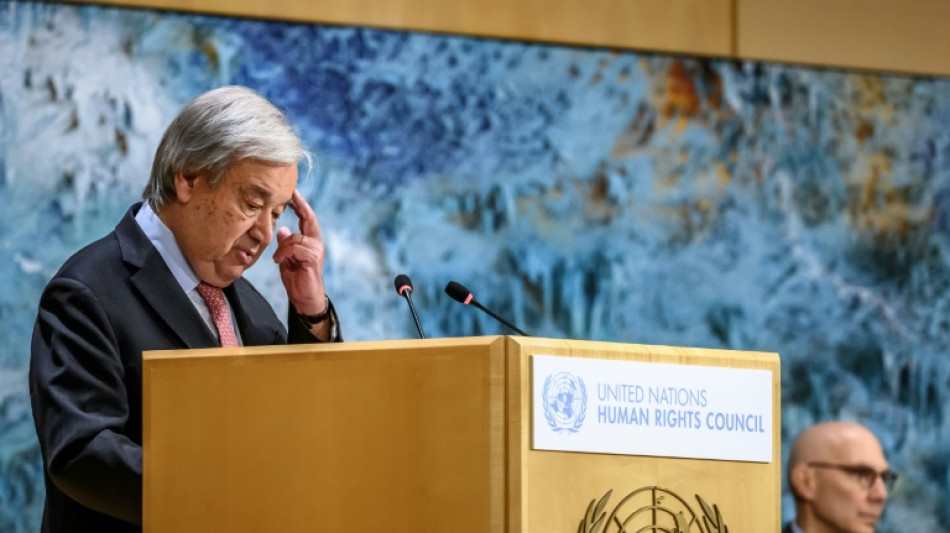
The United Nations leader warned Monday that "the rule of force" was spreading, as the powerful trample on international law and wield artificial intelligence and other technologies to attack human rights.
"Human rights are under a full-scale attack around the world," Antonio Guterres told the opening of the UN Human Rights Council's annual session in Geneva.
"The rule of law is being outmuscled by the rule of force."
The UN secretary-general stressed that "this assault is not coming from the shadows, or by surprise. It is happening in plain sight -- and often led by those who hold the greatest power".
He did not mention specific situations, although he did voice outrage at Russia's war in Ukraine, where he said more than 15,000 civilians had been killed in four years of violence.
"It is more than past time to end the bloodshed," he said.
Guterres also highlighted the "blatant violations of human rights, human dignity and international law in the Occupied Palestinian Territory".
He charged that the trajectory in the conflict-torn territories under Israeli occupation was "stark, clear and purposeful: the two-state solution is being stripped away in broad daylight".
"The international community cannot allow it to happen," he insisted.
- Rights attacked 'deliberately, strategically' -
In his final in-person address to the UN's top rights body, Guterres said the worst conflict-hit areas were not the only places where rights were eroding.
"Around the world, human rights are being pushed back deliberately, strategically and sometimes proudly," he said.
"We are living in a world where mass suffering is excused away, where humans are used as bargaining chips, where international law is treated as a mere inconvenience."
UN rights chief Volker Turk echoed the concerns.
In a "deeply worrying trend", he warned that "domination and supremacy are making a comeback".
"A fierce competition for power, control and resources is playing out on the world stage at a rate and intensity unseen for the past 80 years," he warned.
"The use of force to resolve disputes between and within countries is becoming normalised."
Turk highlighted how "the gears of global power are shifting", calling for people to band together to protect rights and create "a strong counterbalance to the top-down, autocratic trends we see today".
- 'Democracies eroding' -
While the UN says that conflicts are multiplying, impunity is spreading and humanitarian needs are exploding, its traditional top donor, Washington, has dramatically slashed its foreign aid spending since President Donald Trump's returned to power last year. Other major donors have followed.
"When human rights fall, everything else tumbles," Guterres warned.
The crisis of respect for human rights "mirrors and magnifies every other global fracture", he said, pointing out that "inequalities are widening at staggering speed.
At the same time, "climate chaos is accelerating, and technology, especially artificial intelligence, is increasingly being used in ways that suppress rights, deepen inequality and expose marginalised people to new forms of discrimination both online and offline", he warned.
Turk meanwhile lambasted leaders, without naming them, who seem to believe "that they are above the law, and above the UN Charter".
"They claim exceptional status, exceptional danger or exceptional moral judgement to pursue their own agenda at any cost," he said, pointing to how "some weaponise their economic leverage".
"They spread disinformation to distract, silence and marginalise," he charged.
What is clear, Guterres warned, was that "across every front, those who are already vulnerable are being pushed further to the margins".
"Democracies eroding... migrants harassed, arrested and expelled with total disregard for their human rights and their humanity. Refugees scapegoated," he pointed out, also highlighting how "LGBTIQ+ communities (are) vilified, minorities and indigenous peoples targeted, religious communities attacked".
Guterres, who is to step down this year after a decade at the UN helm, called for urgent action to reverse the trend.
"Do not let power write a new rulebook in which the vulnerable have no rights and the powerful have no limits," he said.
J.Michalak--GL