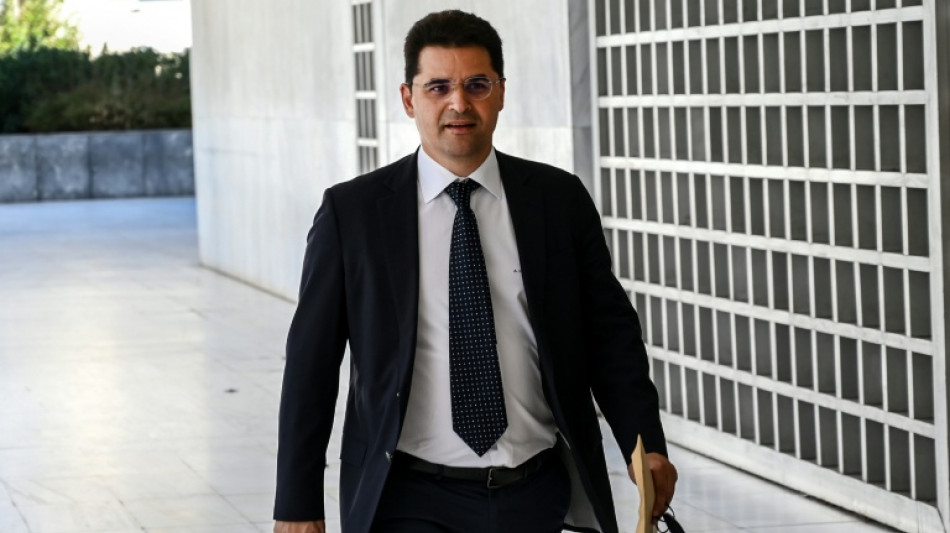
Athens court convicts four over Greece spyware saga / Photo: © AFP

 London
 17 °C
17 °C
 Manchester
16 °C
Manchester
16 °C
 Glasgow
 7 °C
7 °C
 Dublin
15 °C
Dublin
15 °C
 Belfast
 12 °C
12 °C
 Washington
15 °C
Washington
15 °C
 Denver
18 °C
Denver
18 °C
 Atlanta
24 °C
Atlanta
24 °C
 Dallas
30 °C
Dallas
30 °C
 Houston Texas
 30 °C
30 °C
 New Orleans
28 °C
New Orleans
28 °C
 El Paso
19 °C
El Paso
19 °C
 Phoenix
33 °C
Phoenix
33 °C
 Los Angeles
21 °C
San Diego
Los Angeles
21 °C
San Diego
 21 °C
San Francisco
14 °C
Chicago
17 °C
Minneapolis
12 °C
Seattle
16 °C
Portland
18 °C
Salt Lake City
16 °C
Las Vegas
29 °C
Miami
26 °C
Jacksonville
26 °C
San Antonio
30 °C
Bermuda
28 °C
Nassau
15 °C
Iqaluit
4 °C
Yellowknife
9 °C
Anchorage
21 °C
San Francisco
14 °C
Chicago
17 °C
Minneapolis
12 °C
Seattle
16 °C
Portland
18 °C
Salt Lake City
16 °C
Las Vegas
29 °C
Miami
26 °C
Jacksonville
26 °C
San Antonio
30 °C
Bermuda
28 °C
Nassau
15 °C
Iqaluit
4 °C
Yellowknife
9 °C
Anchorage
 10 °C
Fairbanks
5 °C
Barrow
10 °C
Fairbanks
5 °C
Barrow
 1 °C
Calgary
14 °C
Edmonton
18 °C
Winnipeg
14 °C
Goose Bay
11 °C
Halifax
13 °C
Boston
11 °C
Ottawa
8 °C
Toronto
13 °C
Detroit
14 °C
Cleveland
15 °C
New York
16 °C
Baltimore
15 °C
Philadelphia
17 °C
Nuuk (Godthåb)
2 °C
Hong Kong
1 °C
Calgary
14 °C
Edmonton
18 °C
Winnipeg
14 °C
Goose Bay
11 °C
Halifax
13 °C
Boston
11 °C
Ottawa
8 °C
Toronto
13 °C
Detroit
14 °C
Cleveland
15 °C
New York
16 °C
Baltimore
15 °C
Philadelphia
17 °C
Nuuk (Godthåb)
2 °C
Hong Kong
 30 °C
Singapore
30 °C
Melbourne
27 °C
Canberra
19 °C
Adelaide
22 °C
Darwin
30 °C
Singapore
30 °C
Melbourne
27 °C
Canberra
19 °C
Adelaide
22 °C
Darwin
 32 °C
Perth
20 °C
Fort Worth
30 °C
Honolulu
29 °C
Sydney
19 °C
Johannesburg
12 °C
Dubai
30 °C
Mumbai
29 °C
Zürich
8 °C
Tokyo
20 °C
Seoul
28 °C
Delhi
28 °C
Beijing
27 °C
Riyadh
27 °C
Prague
10 °C
Pennsylvania
14 °C
Valletta
24 °C
Manama
32 °C
Warsaw
11 °C
Stockholm
7 °C
32 °C
Perth
20 °C
Fort Worth
30 °C
Honolulu
29 °C
Sydney
19 °C
Johannesburg
12 °C
Dubai
30 °C
Mumbai
29 °C
Zürich
8 °C
Tokyo
20 °C
Seoul
28 °C
Delhi
28 °C
Beijing
27 °C
Riyadh
27 °C
Prague
10 °C
Pennsylvania
14 °C
Valletta
24 °C
Manama
32 °C
Warsaw
11 °C
Stockholm
7 °C
A Greek court convicted four people Thursday over a long-running wiretapping scandal that rocked the government in 2022, prompting resignations and a vote of no confidence in parliament.
The Athens court convicted the four, who include two Israelis, to eight years in prison. They remain free pending an appeal trial.
In an affair local media dubbed the "Greek Watergate", the men used Predator software to tap the phones of more 90 politicians, journalists, business leaders and senior military officials between 2020 and 2022.
The defendants include Tal Dilian, a former Israeli soldier and founder of Intellexa, a company specialising in the supply of spyware, which marketed the Predator software in Greece.
His partner as well as two former Greek executives of the company, were also convicted.
The defendants, who were not present in court, were convicted of "breaching the confidentiality of telephone communications", said the judge.
They were also found guilty of "tampering with a personal-data filing system ... on a repeated basis," as well as of "illegal access to an information system or data," he added.
Predator is sophisticated software that makes it possible to infiltrate mobile phones, access messages and photos, and even remotely activate the microphone and camera.
- "A good day for democracy" -
The affair broke in early 2022 when a Greek investigative journalist, Thanassis Koukakis, discovered he had been wiretapped by the intelligence services (EYP) and that his phone had also been infected with the Predator spyware.
Koukakis on Thursday said he was "extremely satisfied" with the ruling, which he termed "fair."
"It was a good day for democracy and the rule of law in Greece," he told AFP outside the courthouse, adding that the verdict "opened the way" for additional prosecutions of suspects in the same case.
"Half of the cabinet and high ranking generals were under surveillance by the national security agency and Predator spyware," said Koukakis.
He insisted there was a "link" between the Greek intelligence agency and the Predator operation, which the government has always denied.
According to the Greek Authority for Communication Security and Privacy watchdog (ADAE), it was used against more than 90 people.
The scandal forced the resignation of senior officials in Prime Minister Kyriakos Mitsotakis's administration.
The affair snowballed into a political scandal in July 2022, when the soon-to-be leader of the socialist Pasok-Kinal party, Nikos Androulakis, revealed that his mobile phone had also been tapped.
At the time, Androulakis was a member of the European Parliament.
The socialist leader on Thursday said the wiretaps "not only blatantly violated human rights and the rule of law, but also jeopardised the country’s security (as) the leadership of the armed forces was shamelessly placed under surveillance, allowing unknown third parties to possess this material."
- A 'cover-up' -
The ruling now enables prosecutors to examine possible espionage charges, Androulakis said in a statement.
He criticised government ministers who had been spied upon, yet chose to stay silent.
"Even though they had a political and institutional duty to be plaintiffs, witnesses... they preferred to remain silent and became complicit in the cover-up," Androulakis said.
The scandal led to the resignation of one of the prime minister's closest aides, his nephew Grigoris Dimitriadis.
The head of the EYP intelligence service also stepped down.
Mitsotakis later weathered a motion of no confidence in parliament over the case.
In July 2024, the Supreme Court cleared the intelligence services and political officials of wrongdoing, angering victims and human rights groups.
Paris-based media rights campaigners Reporters Without Borders (RSF) has described this case as "a fresh blow to media freedom" in Greece.
The Supreme Court questioned only two proven victims of Predator, and the prosecutor did not request access to the bank accounts of the company that marketed the software.
The Greek employees who, in December 2021, hurriedly moved the servers out of their office were not questioned either.
"One may wonder whether the case was really investigated or whether everything was done to bury it," Androulakis's lawyer, Christos Kaklamanis, told the court.
The socialist leader has filed an appeal with the European Court of Human Rights (ECHR).
C.Bak--GL