'We unleashed the beast': the world's fears and hopes about AI / Photo: © AFP/File

 London
 18 °C
18 °C

 Manchester
16 °C
Manchester
16 °C
 Glasgow
19 °C
Glasgow
19 °C
 Dublin
15 °C
Dublin
15 °C
 Belfast
15 °C
Belfast
15 °C
 Washington
 14 °C
14 °C
 Denver
 20 °C
20 °C
 Atlanta
23 °C
Atlanta
23 °C
 Dallas
 29 °C
29 °C
 Houston Texas
28 °C
Houston Texas
28 °C
 New Orleans
26 °C
New Orleans
26 °C
 El Paso
22 °C
El Paso
22 °C
 Phoenix
29 °C
Phoenix
29 °C
 Los Angeles
21 °C
San Diego
20 °C
San Francisco
14 °C
Chicago
21 °C
Minneapolis
15 °C
Seattle
13 °C
Portland
12 °C
Salt Lake City
12 °C
Las Vegas
27 °C
Miami
Los Angeles
21 °C
San Diego
20 °C
San Francisco
14 °C
Chicago
21 °C
Minneapolis
15 °C
Seattle
13 °C
Portland
12 °C
Salt Lake City
12 °C
Las Vegas
27 °C
Miami
 27 °C
Jacksonville
25 °C
San Antonio
27 °C
Bermuda
27 °C
Nassau
15 °C
Iqaluit
3 °C
Yellowknife
6 °C
Anchorage
12 °C
Fairbanks
6 °C
Barrow
-1 °C
Calgary
7 °C
Edmonton
19 °C
Winnipeg
13 °C
Goose Bay
13 °C
Halifax
10 °C
Boston
10 °C
Ottawa
7 °C
Toronto
15 °C
Detroit
18 °C
Cleveland
15 °C
New York
16 °C
Baltimore
14 °C
Philadelphia
14 °C
Nuuk (Godthåb)
27 °C
Jacksonville
25 °C
San Antonio
27 °C
Bermuda
27 °C
Nassau
15 °C
Iqaluit
3 °C
Yellowknife
6 °C
Anchorage
12 °C
Fairbanks
6 °C
Barrow
-1 °C
Calgary
7 °C
Edmonton
19 °C
Winnipeg
13 °C
Goose Bay
13 °C
Halifax
10 °C
Boston
10 °C
Ottawa
7 °C
Toronto
15 °C
Detroit
18 °C
Cleveland
15 °C
New York
16 °C
Baltimore
14 °C
Philadelphia
14 °C
Nuuk (Godthåb)
 6 °C
Hong Kong
6 °C
Hong Kong
 30 °C
Singapore
32 °C
Melbourne
26 °C
Canberra
11 °C
Adelaide
12 °C
Darwin
30 °C
Singapore
32 °C
Melbourne
26 °C
Canberra
11 °C
Adelaide
12 °C
Darwin
 30 °C
Perth
24 °C
Fort Worth
28 °C
Honolulu
25 °C
Sydney
18 °C
Johannesburg
18 °C
Dubai
40 °C
Mumbai
30 °C
Zürich
20 °C
Tokyo
26 °C
Seoul
25 °C
Delhi
33 °C
Beijing
30 °C
Perth
24 °C
Fort Worth
28 °C
Honolulu
25 °C
Sydney
18 °C
Johannesburg
18 °C
Dubai
40 °C
Mumbai
30 °C
Zürich
20 °C
Tokyo
26 °C
Seoul
25 °C
Delhi
33 °C
Beijing
 28 °C
Riyadh
42 °C
Prague
18 °C
Pennsylvania
10 °C
Valletta
28 °C
Manama
40 °C
Warsaw
17 °C
Stockholm
17 °C
28 °C
Riyadh
42 °C
Prague
18 °C
Pennsylvania
10 °C
Valletta
28 °C
Manama
40 °C
Warsaw
17 °C
Stockholm
17 °C
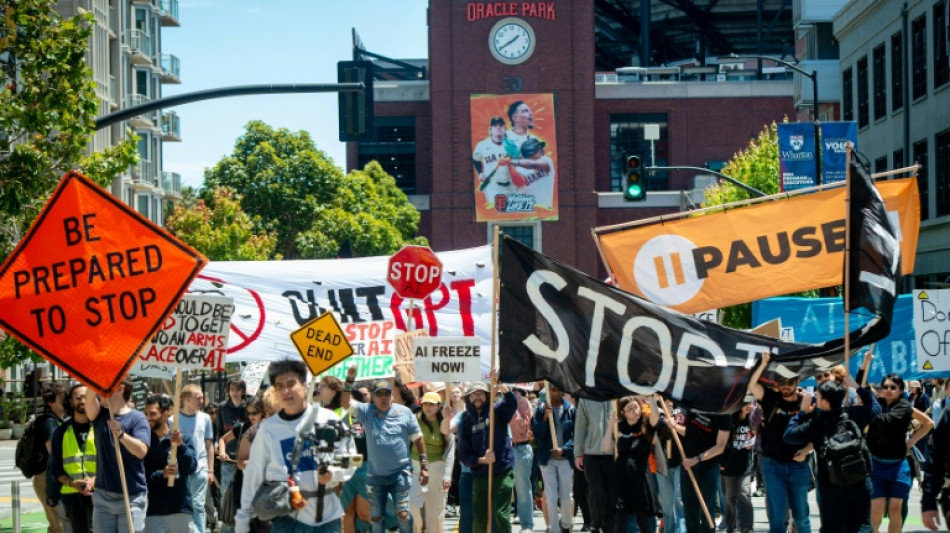
The threat of catastrophic danger as artificial intelligence develops at high speed has sparked a global debate on how it should be regulated.
AFP spoke to people in different countries about their fears and hopes for the AI future, as leading US labs call for a coordinated slowdown of their cutting-edge work on the technology.
- Italy: 'Privately, it scares me' -
Beside ancient buildings in central Rome, 43-year-old architect Frida Awrohum said she tries to use AI tools in her professional life because they offer fresh ideas.
"But privately it still scares me," she confided, adding she prioritises the "human" aspect of her work.
Diego Sermattei, 18, said AI can be very helpful for students like himself, because "you just have to look something up and it finds it for you right away".
- Indonesia: 'Could any human respond better?' -
"Sometimes when I share my personal life with AI, I think, would there be any human who could respond to me as well as AI does?" said 18-year-old student Astrid Anindya.
Anindya uses several chatbots to find information -- and to help her use effective wording when applying for jobs.
"Sometimes they give wrong information. So, usually I do a crosscheck, from ChatGPT to Gemini," she said, referring respectively to OpenAI's and Google's flagship products.
- United States: 'Unleashed the beast' -
"AI is here. We unleashed the beast," said Maliyka Muhammad, a 46-year-old analyst for New York State, who thinks "a consortium of people" would be best to regulate it.
San Francisco software engineer Lucy Pen, 30, has already seen her job shift from writing code herself to having AI agents write it for her too.
"Maybe in the future they don't need me to give commands to AI anymore," she said.
Brian Diaz, a 26-year-old nurse in New York, said that "humanity has to develop", even though in the wrong hands AI could cause harm.
"You're either gonna be with it or you're gonna get left (behind)," Diaz said.
- China: 'Real hardship' -
On the streets of Shanghai, 42-year-old Xie Zongbo said "no new technology develops completely smoothly".
"We will slowly learn to minimise its negative impacts, so its positive aspects can better serve humanity and offer greater convenience," he said.
Jenny, a 50-year-old pharmaceutical worker who declined to give her surname, said that "businesses cannot possibly regulate themselves".
Instead they must be restrained through policies and laws, she said.
Businessman Yang Shuai, 42, feared that future generations would "face real hardship" due to hurdles encountered when searching for jobs.
- Chile: 'Making us dumber' -
Advertising student Catalina Cruz, 19, thinks AI is "making us dumber" because "people aren't able to think for themselves any more".
"There's also the environmental issue, because it uses too much water," she said, saying the technology "definitely needs to be regulated".
But Constanza Medel, a 29-year-old occupational therapist, sees AI "as a clear benefit as long as you take the proper precautions".
- France: 'Letting things happen' -
Train driver-in-training Romain Hamel, 34, said in Paris that AI was developing so quickly that "we don't have enough perspective yet".
"We're not putting enough barriers in place at the moment -- we're letting things happen," with the race driven by the United States and China.
"I don't want to say there's not enough regulation, because in Europe we regulate a lot, and I think more frameworks should be introduced to prevent abuse, or us losing control over it."
- Israel: 'Can finish us' -
"Like the internet, each country has its own authority, but we still need something global," said software engineer Tal Reinfeld.
Video creator Yotam Katzor, 32, worried about what would happen when humans were no longer the smartest thing on Earth.
"If it wants, it can finish us. But we still have the power to win" through regulation, he said.
- Japan: 'AI doesn't have emotions' -
Atsukuni Tabata, 56, who works at an advertising company, said it was "scary" not knowing what AI would do as it "accumulates more and more data".
But part-time service industry worker Konno Hazuki, 29, does not feel she is "about to be replaced by AI".
"Because AI doesn't have emotions, there are things it just can't offer customers," Hazuki said.
burs-kaf/mjw
P.Majewski--GL