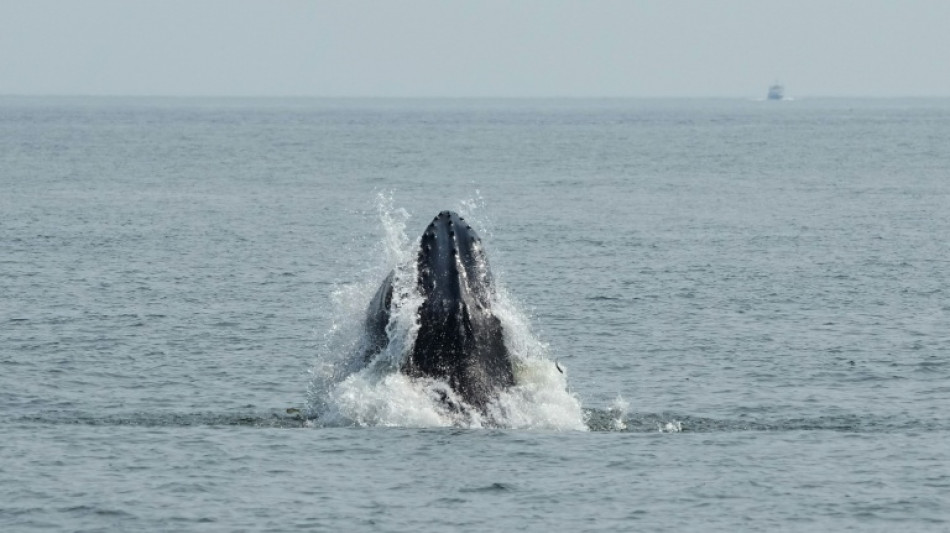
Whales spark joy in New York but face threats from boat traffic / Photo: © AFP

 London
 21 °C
21 °C

 Manchester
 16 °C
16 °C
 Glasgow
14 °C
Glasgow
14 °C
 Dublin
19 °C
Dublin
19 °C
 Belfast
18 °C
Belfast
18 °C
 Washington
26 °C
Washington
26 °C
 Denver
 32 °C
32 °C
 Atlanta
 31 °C
31 °C
 Dallas
38 °C
Dallas
38 °C
 Houston Texas
32 °C
Houston Texas
32 °C
 New Orleans
32 °C
New Orleans
32 °C
 El Paso
30 °C
El Paso
30 °C
 Phoenix
44 °C
Phoenix
44 °C
 Los Angeles
 29 °C
San Diego
27 °C
San Francisco
29 °C
San Diego
27 °C
San Francisco
 17 °C
Chicago
23 °C
Minneapolis
25 °C
Seattle
25 °C
Portland
29 °C
Salt Lake City
34 °C
Las Vegas
42 °C
Miami
17 °C
Chicago
23 °C
Minneapolis
25 °C
Seattle
25 °C
Portland
29 °C
Salt Lake City
34 °C
Las Vegas
42 °C
Miami
 30 °C
Jacksonville
31 °C
San Antonio
36 °C
Bermuda
26 °C
Nassau
23 °C
Iqaluit
7 °C
Yellowknife
17 °C
Anchorage
30 °C
Jacksonville
31 °C
San Antonio
36 °C
Bermuda
26 °C
Nassau
23 °C
Iqaluit
7 °C
Yellowknife
17 °C
Anchorage
 16 °C
Fairbanks
18 °C
Barrow
5 °C
Calgary
23 °C
Edmonton
26 °C
Winnipeg
18 °C
Goose Bay
21 °C
Halifax
21 °C
Boston
22 °C
Ottawa
22 °C
Toronto
22 °C
Detroit
23 °C
Cleveland
21 °C
New York
25 °C
Baltimore
25 °C
Philadelphia
26 °C
Nuuk (Godthåb)
11 °C
Hong Kong
31 °C
Singapore
29 °C
Melbourne
31 °C
Canberra
12 °C
Adelaide
17 °C
Darwin
28 °C
Perth
13 °C
Fort Worth
37 °C
Honolulu
29 °C
Sydney
16 °C
Johannesburg
10 °C
Dubai
34 °C
Mumbai
28 °C
Zürich
18 °C
Tokyo
29 °C
Seoul
28 °C
Delhi
29 °C
Beijing
27 °C
Riyadh
33 °C
Prague
15 °C
Pennsylvania
25 °C
Valletta
28 °C
Manama
34 °C
Warsaw
14 °C
Stockholm
16 °C
Fairbanks
18 °C
Barrow
5 °C
Calgary
23 °C
Edmonton
26 °C
Winnipeg
18 °C
Goose Bay
21 °C
Halifax
21 °C
Boston
22 °C
Ottawa
22 °C
Toronto
22 °C
Detroit
23 °C
Cleveland
21 °C
New York
25 °C
Baltimore
25 °C
Philadelphia
26 °C
Nuuk (Godthåb)
11 °C
Hong Kong
31 °C
Singapore
29 °C
Melbourne
31 °C
Canberra
12 °C
Adelaide
17 °C
Darwin
28 °C
Perth
13 °C
Fort Worth
37 °C
Honolulu
29 °C
Sydney
16 °C
Johannesburg
10 °C
Dubai
34 °C
Mumbai
28 °C
Zürich
18 °C
Tokyo
29 °C
Seoul
28 °C
Delhi
29 °C
Beijing
27 °C
Riyadh
33 °C
Prague
15 °C
Pennsylvania
25 °C
Valletta
28 °C
Manama
34 °C
Warsaw
14 °C
Stockholm
 13 °C
13 °C
"WHALE AT ONE O'CLOCK!"
Eager cruise passengers zipping around New York's southern shores rush to the starboard bow: a humpback whale is up for air, a breathtaking sighting set against Manhattan's iconic skyline.
Such scenes are no longer uncommon in the city's waterways, sparking excitement for animal lovers but also forcing new policy efforts to protect whales venturing into one of the busiest port regions in the United States.
Once hunted to near extinction, the rebound of humpback whales is considered among the conservation movement's greatest success stories.
And a growing cohort of mostly juvenile humpbacks are thriving off New York's coast, where food is now plentiful.
"People fly to different parts of the world to go on safari, and what I think a lot of people don't realize is that the marine safari is right out here," said Carl LoBue, New York oceans director at The Nature Conservancy.
The marine scientist who grew up on nearby Long Island told AFP that in the past, whale sightings were an "incredibly unusual event."
LoBue now spots the marine mammals basically every time he's out on the water. He generally sees humpbacks but sometimes other species including the still critically endangered North Atlantic Right whale.
The new normal is "spectacular," he said.
"I never thought that I would see whales like this off the coast of New York."
- Cleaner water, climate change and more fish -
Humpbacks were once mainly migratory visitors, traversing the New York Bight -- the marine region that extends off the city, Long Island and New Jersey -- while traveling between foraging grounds further north and breeding areas in the Caribbean.
But more recently, a confluence of factors has made New York's coast less of a highway and more of a stomping ground.
One is the resurgence of whale populations thanks to government action including the Endangered Species Act, as well as a cleaner habitat supported by air and water protections.
Another is the existence of relatively new statutes that support growing schools of the Atlantic menhaden, an oily fish with a variety of industrial uses like commercial bait and omega-3 supplements.
It is also a staple for whales, dolphins and seabirds.
Humpbacks, which can grow to the size of a large city bus, can feast on some 3,000 pounds (1360 kilograms) of fish a day.
Climate change also plays a role in the surge of New York-area whale sightings.
Warming waters are impacting bait fish distributions, encouraging whales to stray from tradition to find food, said Chris St. Lawrence, a naturalist who conducts whale watching tours and also works for Gotham Whale, a marine research organization that tracks whales in the Bight.
When Gotham began formally monitoring in 2012, they had just five whales in their catalog.
Today, St. Lawrence said the organization sees 80 to 100 unique whales annually, and just identified its 500th individual whale seen around New York City since tracking began.
Some routinely put on a show: NYC0318, a whale also seen by AFP on a recent outing, often charms whale watchers with sensational lunge-feeds, breaching the water and prompting shrieks of delight.
- Maritime traffic dangers -
Gotham is able to distinguish between the animals largely thanks to "fluke prints": whales have unique patterns on the underside of their tails, similar to human fingerprints, St. Lawrence explained.
But many whales are also identifiable by their scars, including from collisions with everything from tankers, cargo and cruise ships to fishing boats and recreational vessels.
Because while New York offers bountiful food, it also hosts heavy maritime traffic, posing fresh threats to the whale population.
In 2016, humpbacks in the New York area were delisted as endangered, but just one year later the US National Oceanic and Atmospheric Administration (NOAA) declared an "Unusual Mortality Event" along the Atlantic coast.
The designation under the US Marine Mammal Protection Act tracks unexpected die-offs and triggers investigation. For humpbacks, it remains in effect.
Vessel strikes and entanglements are leading causes of whale deaths, according to advocacy groups and government trackers worldwide.
Just this month, New York Governor Kathy Hochul signed the Whale Awareness Act, which requires integrating marine mammal protection efforts and education into state boater safety courses and vessel registration.
LoBue has worked to develop educational materials, including an online course that teaches seafarers how to recognize whale behavior, report sightings and avoid collision.
He noted that even the most seasoned fishermen "didn't grow up driving boats around whales because they didn't used to be here."
"We're all needing to learn some new skills," he said.
"Nobody wants to hit a whale."
F.Jablonski--GL