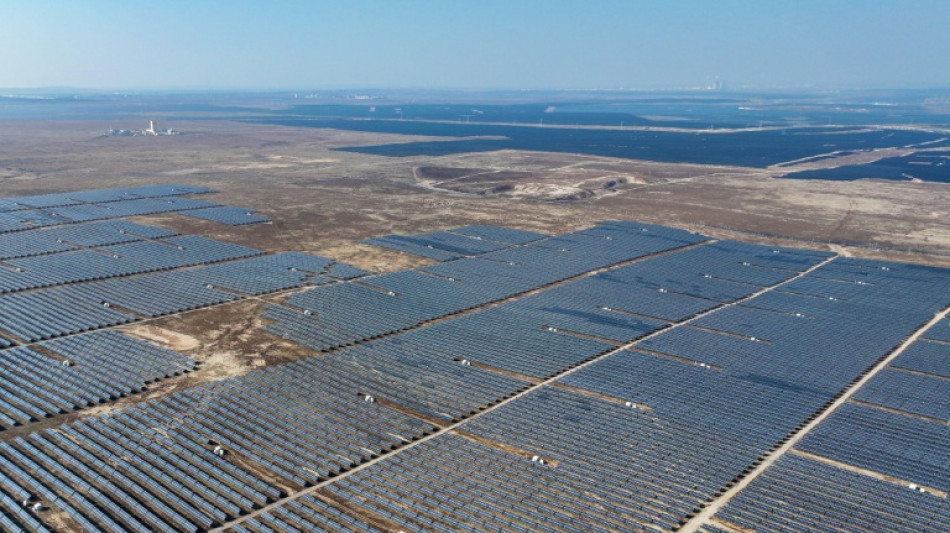
China's rapid solar expansion hurt bird diversity: study / Photo: © CN-STR/AFP/File

 London
 18 °C
18 °C

 Manchester
15 °C
Manchester
15 °C
 Glasgow
15 °C
Glasgow
15 °C
 Dublin
 16 °C
16 °C
 Belfast
15 °C
Belfast
15 °C
 Washington
32 °C
Washington
32 °C
 Denver
 31 °C
31 °C
 Atlanta
36 °C
Atlanta
36 °C
 Dallas
40 °C
Dallas
40 °C
 Houston Texas
37 °C
Houston Texas
37 °C
 New Orleans
35 °C
New Orleans
35 °C
 El Paso
34 °C
El Paso
34 °C
 Phoenix
38 °C
Phoenix
38 °C
 Los Angeles
30 °C
San Diego
28 °C
San Francisco
17 °C
Chicago
Los Angeles
30 °C
San Diego
28 °C
San Francisco
17 °C
Chicago
 25 °C
Minneapolis
23 °C
Seattle
25 °C
Portland
27 °C
Salt Lake City
36 °C
Las Vegas
39 °C
Miami
25 °C
Minneapolis
23 °C
Seattle
25 °C
Portland
27 °C
Salt Lake City
36 °C
Las Vegas
39 °C
Miami
 32 °C
Jacksonville
34 °C
San Antonio
37 °C
Bermuda
31 °C
Nassau
27 °C
Iqaluit
10 °C
Yellowknife
14 °C
Anchorage
12 °C
Fairbanks
13 °C
Barrow
6 °C
Calgary
24 °C
Edmonton
30 °C
Winnipeg
22 °C
Goose Bay
21 °C
Halifax
27 °C
Boston
29 °C
Ottawa
24 °C
Toronto
24 °C
Detroit
27 °C
Cleveland
26 °C
New York
27 °C
Baltimore
31 °C
Philadelphia
28 °C
Nuuk (Godthåb)
11 °C
Hong Kong
32 °C
Jacksonville
34 °C
San Antonio
37 °C
Bermuda
31 °C
Nassau
27 °C
Iqaluit
10 °C
Yellowknife
14 °C
Anchorage
12 °C
Fairbanks
13 °C
Barrow
6 °C
Calgary
24 °C
Edmonton
30 °C
Winnipeg
22 °C
Goose Bay
21 °C
Halifax
27 °C
Boston
29 °C
Ottawa
24 °C
Toronto
24 °C
Detroit
27 °C
Cleveland
26 °C
New York
27 °C
Baltimore
31 °C
Philadelphia
28 °C
Nuuk (Godthåb)
11 °C
Hong Kong
 26 °C
Singapore
26 °C
Singapore
 28 °C
Melbourne
32 °C
Canberra
11 °C
Adelaide
28 °C
Melbourne
32 °C
Canberra
11 °C
Adelaide
 10 °C
Darwin
10 °C
Darwin
 22 °C
Perth
12 °C
Fort Worth
40 °C
Honolulu
28 °C
Sydney
15 °C
Johannesburg
15 °C
Dubai
36 °C
Mumbai
28 °C
Zürich
21 °C
Tokyo
27 °C
Seoul
25 °C
Delhi
31 °C
Beijing
25 °C
Riyadh
36 °C
Prague
22 °C
Pennsylvania
25 °C
Valletta
29 °C
Manama
35 °C
Warsaw
20 °C
Stockholm
17 °C
22 °C
Perth
12 °C
Fort Worth
40 °C
Honolulu
28 °C
Sydney
15 °C
Johannesburg
15 °C
Dubai
36 °C
Mumbai
28 °C
Zürich
21 °C
Tokyo
27 °C
Seoul
25 °C
Delhi
31 °C
Beijing
25 °C
Riyadh
36 °C
Prague
22 °C
Pennsylvania
25 °C
Valletta
29 °C
Manama
35 °C
Warsaw
20 °C
Stockholm
17 °C
The global push for solar energy expansion could carry hidden biodiversity costs, according to a study across China published in the journal Science on Thursday.
According to the research spanning more than 2,300 Chinese counties, pro-solar policies led to reductions in bird diversity in what the authors called an example of a "green dilemma" pitting carbon reduction against conservation.
"The main message is not to slow the renewable energy transition, but to make solar development more ecologically informed," first author Huiming Zhang, of the Nanjing University of Information Science & Technology, told AFP.
China's goal to achieve net zero before 2060 has seen it embark on a renewables revolution.
By 2024 its solar footprint reached an estimated 4,520 square kilometers (1,745 square miles) -- equivalent in size to the US state of Rhode Island -- and solar energy is projected to constitute 45 percent of its energy mix by 2060.
Choosing solar locations in China isn't just based on sunny locations and available land, but rather it is shaped by "Five-Year Plans" to promote economic development in certain regions.
Zhang and his colleagues exploited these variations in solar expansion policy across 2,344 counties across China from 2014 to 2023, while also accounting for national trends, weather, socioeconomic conditions, land cover, and birdwatching effort.
This data was paired with citizen science records to understand the impact on bird diversity.
Their findings revealed a negative trade off, with increased policy stringency consistently associated with decreased bird biodiversity, though the effect was moderate.
Using an index from 0 to 15.5 to measure the strength of solar policies, the study found that a four-point increase in policy strength was linked to a two percent decline in the Shannon index, a standard measure of species variety.
Rapid land conversion was the main culprit, particularly the transformation of cropland and grassland into developed areas, with the effects stronger in wealthier and non-desert regions.
Both resident and migratory birds suffered significant declines, but species that were native to mountain habitats poorly suited to solar farms were unaffected.
- 'Inferior greening' -
The push for solar farms was accompanied by greening efforts to satisfy environmental requirements, but here the authors identified what they called "inferior greening" -- where the total amount of leafiness may go up but because it was too homogenous, the ecological quality went down.
Writing in a related commentary, Yuanning Liang of Peking University said "birds serve as an effective indicator group for large-scale biodiversity assessment" because they are among the few animal groups for which abundance data over time and space is readily available.
Although the authors studied solar power, the siting problems they identified are relevant to renewable infrastructure more broadly, including wind power, she added.
The research team offered a number of recommendations, including directing large solar projects toward locations with lower ecological conflict, greater assessments of each site, and limiting land conversion in productive, habitat-rich regions.
"Clean energy development and biodiversity conservation do not have to come at each other's expense, but careful siting and biodiversity safeguards are essential," said Zhang.
K.Radomski--GL