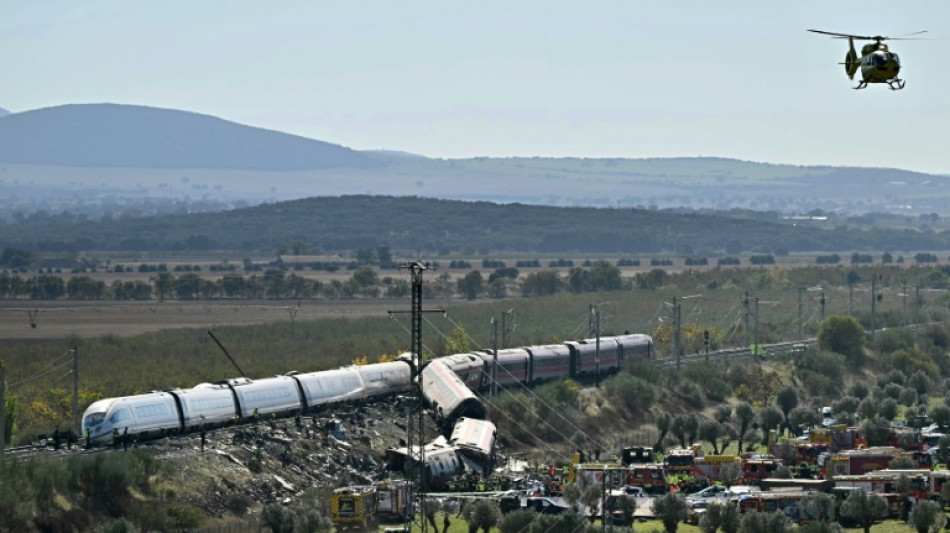
What we know about Spain's deadly train crash / Photo: © AFP

 London
 16 °C

 Manchester
14 °C
 Glasgow
14 °C
 Dublin
 15 °C
 Belfast
15 °C
 Washington
14 °C
 Denver
 5 °C
 Atlanta
 14 °C
 Dallas
19 °C
 Houston Texas
20 °C
 New Orleans
 18 °C
 El Paso
15 °C
 Phoenix
19 °C
 Los Angeles
17 °C
San Diego
19 °C
San Francisco
12 °C
Chicago
17 °C
Minneapolis
6 °C
Seattle
7 °C
Portland
8 °C
Salt Lake City
9 °C
Las Vegas
15 °C
Miami
26 °C
Jacksonville
 22 °C
San Antonio
 21 °C
Bermuda
23 °C
Nassau
13 °C
Iqaluit
-12 °C
Yellowknife
-4 °C
Anchorage
 3 °C
Fairbanks
 -1 °C
Barrow
 1 °C
Calgary
-4 °C
Edmonton
14 °C
Winnipeg
2 °C
Goose Bay
12 °C
Halifax
11 °C
Boston
11 °C
Ottawa
2 °C
Toronto
10 °C
Detroit
14 °C
Cleveland
14 °C
New York
14 °C
Baltimore
14 °C
Philadelphia
13 °C
Nuuk (Godthåb)
0 °C
Hong Kong
26 °C
Singapore
27 °C
Melbourne
26 °C
Canberra
8 °C
Adelaide
18 °C
Darwin
 30 °C
Perth
18 °C
Fort Worth
20 °C
Honolulu
24 °C
Sydney
18 °C
Johannesburg
29 °C
Dubai
32 °C
Mumbai
31 °C
Zürich
12 °C
Tokyo
14 °C
Seoul
10 °C
Delhi
21 °C
Beijing
15 °C
Riyadh
36 °C
Prague
12 °C
Pennsylvania
12 °C
Valletta
23 °C
Manama
32 °C
Warsaw
10 °C
Stockholm
9 °C
At least 69 people have been killed and more than 100 injured after two high-speed trains collided south of Madrid on Wednesday, in Spain's deadliest rail disaster since 2013.
Here is what we know about the crash, the second serious rail accident to strike the country this year.
- Where and when did it happen? -
The crash happened at 08:53 am (0753 GMT) on Wednesday on a straight stretch of track near the village of Urda, around 130 kilometres (80 miles) south of Madrid.
A service by state operator Renfe with nearly 400 passengers ploughed into the back of a stationary train belonging to private Spanish company Iryo with 152 people on board.
Both trains had departed Madrid's Atocha station bound for the southern city of Seville -- the Iryo train at 7:54 and Renfe's six minutes later.
- What caused the crash? -
At around 8:30 am, an automatic signalling system known as LZB failed.
The system is supposed to monitor train speeds and movements to help prevent collisions by maintaining safe distances between them.
The failure forced six trains on a 69-kilometre stretch of track to stop, including the two involved in the collision.
Control of rail traffic was transferred to the Madrid control centre, which authorised the Renfe train to resume its journey despite the signalling failure.
Transport Minister Oscar Puente called the decision "inexplicable", saying a red signal should have kept the train stationary because the Iryo service was still on the same track.
Puente said he did not know how fast the Renfe train was travelling at the time of the collision, adding that speeds on that section of track could reach 200 kilometres per hour.
- What was the aftermath? -
The force of the impact sent two carriages of the Iryo train down an embankment, leaving them partially reduced to twisted wreckage.
With the death toll still provisional, the crash is Spain's deadliest rail disaster since a derailment near Santiago de Compostela in the northwest killed 80 people in 2013.
It is the country's second rail tragedy this year, after a collision between two high-speed trains in the southern region of Andalusia in January killed 46 people.
- What happens now? -
An investigation is under way to establish the cause of the crash, with questions raised over rail infrastructure maintenance and passenger safety.
Prime Minister Pedro Sanchez has pledged a full investigation "to establish every last detail of this tragedy and strengthen safety measures to ensure it never happens again".
Rail services remain suspended between Madrid and Andalusia.
Renfe has said it will provide alternative transport along the route from Friday, ahead of the All Saints' Day long weekend, when families traditionally visit cemeteries to lay flowers on the graves of relatives.
Y.Slowik--GL