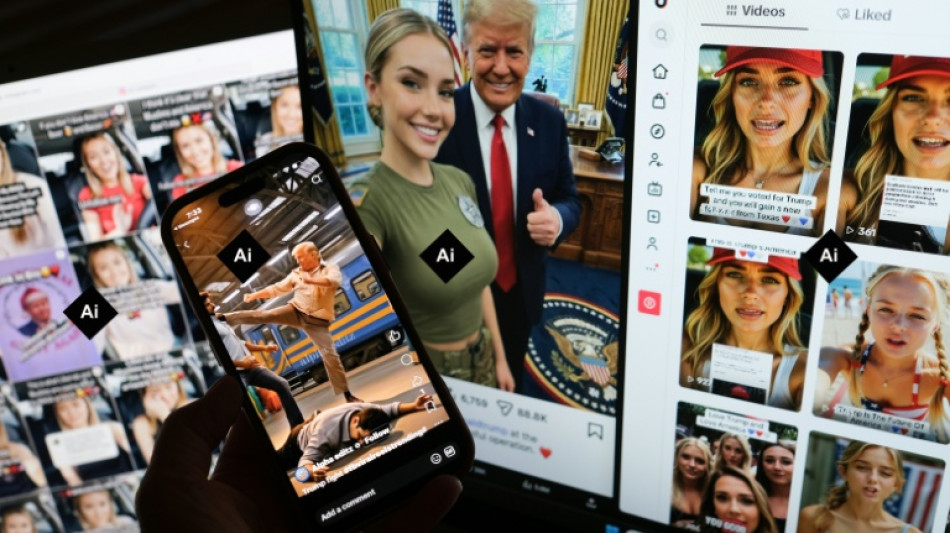
Fervent and fake: High-glam AI avatars boost Trump ahead of midterms / Photo: © AFP

 London
 14 °C
14 °C

 Manchester
 12 °C
12 °C
 Glasgow
14 °C
Glasgow
14 °C
 Dublin
12 °C
Dublin
12 °C
 Belfast
12 °C
Belfast
12 °C
 Washington
26 °C
Washington
26 °C
 Denver
25 °C
Denver
25 °C
 Atlanta
 31 °C
31 °C
 Dallas
36 °C
Dallas
36 °C
 Houston Texas
30 °C
Houston Texas
30 °C
 New Orleans
30 °C
New Orleans
30 °C
 El Paso
 33 °C
33 °C
 Phoenix
32 °C
Phoenix
32 °C
 Los Angeles
25 °C
San Diego
24 °C
San Francisco
21 °C
Chicago
21 °C
Minneapolis
21 °C
Seattle
24 °C
Portland
30 °C
Salt Lake City
28 °C
Las Vegas
34 °C
Miami
Los Angeles
25 °C
San Diego
24 °C
San Francisco
21 °C
Chicago
21 °C
Minneapolis
21 °C
Seattle
24 °C
Portland
30 °C
Salt Lake City
28 °C
Las Vegas
34 °C
Miami
 27 °C
Jacksonville
27 °C
Jacksonville
 28 °C
San Antonio
34 °C
Bermuda
28 °C
Nassau
24 °C
Iqaluit
4 °C
Yellowknife
9 °C
Anchorage
15 °C
Fairbanks
11 °C
Barrow
0 °C
Calgary
22 °C
Edmonton
32 °C
Winnipeg
16 °C
Goose Bay
20 °C
Halifax
23 °C
Boston
23 °C
Ottawa
20 °C
Toronto
22 °C
Detroit
19 °C
Cleveland
23 °C
New York
27 °C
Baltimore
26 °C
Philadelphia
26 °C
Nuuk (Godthåb)
28 °C
San Antonio
34 °C
Bermuda
28 °C
Nassau
24 °C
Iqaluit
4 °C
Yellowknife
9 °C
Anchorage
15 °C
Fairbanks
11 °C
Barrow
0 °C
Calgary
22 °C
Edmonton
32 °C
Winnipeg
16 °C
Goose Bay
20 °C
Halifax
23 °C
Boston
23 °C
Ottawa
20 °C
Toronto
22 °C
Detroit
19 °C
Cleveland
23 °C
New York
27 °C
Baltimore
26 °C
Philadelphia
26 °C
Nuuk (Godthåb)
 4 °C
Hong Kong
27 °C
Singapore
28 °C
Melbourne
29 °C
Canberra
9 °C
Adelaide
16 °C
Darwin
27 °C
Perth
16 °C
Fort Worth
36 °C
Honolulu
29 °C
Sydney
17 °C
Johannesburg
12 °C
Dubai
31 °C
Mumbai
4 °C
Hong Kong
27 °C
Singapore
28 °C
Melbourne
29 °C
Canberra
9 °C
Adelaide
16 °C
Darwin
27 °C
Perth
16 °C
Fort Worth
36 °C
Honolulu
29 °C
Sydney
17 °C
Johannesburg
12 °C
Dubai
31 °C
Mumbai
 27 °C
Zürich
14 °C
Tokyo
23 °C
Seoul
22 °C
Delhi
25 °C
Beijing
20 °C
Riyadh
28 °C
Prague
12 °C
Pennsylvania
27 °C
Valletta
26 °C
Manama
33 °C
Warsaw
11 °C
Stockholm
13 °C
27 °C
Zürich
14 °C
Tokyo
23 °C
Seoul
22 °C
Delhi
25 °C
Beijing
20 °C
Riyadh
28 °C
Prague
12 °C
Pennsylvania
27 °C
Valletta
26 °C
Manama
33 °C
Warsaw
11 °C
Stockholm
13 °C
Clad in swimsuits or military fatigues, the blonde women lavish praise on President Donald Trump and tear into his rivals -- but these influencers are AI-generated, flooding tech platforms with fervent political messaging ahead of the US midterm election.
The rise of hyper-realistic AI avatars -- parroting Trump's political slogans such as "America First" and echoing his talking points on issues such as immigration -- underscores the use of new technology in efforts to energize his Make America Great Again (MAGA) conservative base.
"Where are all my MAGA friends at? If you voted for Trump, say it loud in the comments and you've got yourself a new follower from Texas," an AI-created woman declares on TikTok, sporting a red MAGA hat.
"Trump is the future of America," reads text overlaid on another AI-generated TikTok video depicting a teenage girl on a beach, US flag fluttering in the background.
In an Instagram clip set to the Village People's "YMCA," an avatar portraying a "MAGA patriot" says she "came out of the closet as a Trump supporter."
It's not clear who is behind the AI accounts and whether they are part of a coordinated influence operation ahead of the November elections that will determine whether Republicans maintain control of Congress.
Earlier this year, Trump himself posted on his Truth Social platform a video of a platinum blonde AI avatar -- sporting the high-glam look popular among his fans -- that pushed unfounded corruption allegations against California's Democratic Governor Gavin Newsom.
- 'Shape public opinion' -
In recent months, US media have detected hundreds of AI-generated pro-Trump influencers -- young men and women depicted in military fatigues or dressed as immigration agents -- commenting on hot-button political issues including abortion and the Iran conflict.
The Governance and Responsible AI Lab (GRAIL) at Purdue University has also tracked numerous such accounts across TikTok, Instagram and Facebook.
"The growing wave of political AI influencers amid the 2026 elections is a glimpse into a future where hyper-targeted AI content can be used to shape public opinion," Andrew Yoon of CivAI, a nonprofit focused on AI's capabilities and dangers, told AFP.
Such content is "increasingly difficult to detect, especially when made by sophisticated operators," Yoon said.
As AI technology becomes more and more sophisticated, online manipulation using phony influencers could "become even more personalized and difficult to control," he added.
One AI influencer on Instagram -- featuring a lifelike female soldier posing alongside Trump -- amassed nearly a million followers before the account was suspended.
Referring to the synthetic soldier, Justine Moore, an AI-focused partner at Silicon Valley investor Andreessen Horowitz, wrote on X: "I'm genuinely floored by how many dudes are following influencers that are clearly AI."
- 'Financial profit' -
The influencers compete for online attention with anti-Trump AI accounts, including a Facebook page that depicts the president riding a tricycle down a rubbish-strewn street in grubby clothes or fleeing a sword-wielding mob.
Disinformation typically surges around elections, propelled by automated bots, trolls and phony accounts that amplify false narratives and push them into mainstream political discourse.
The potential for manipulation is multiplying with AI.
Researchers warn that AI deepfakes -- used to target global leaders including French President Emmanuel Macron and Ukraine's President Volodymyr Zelensky -- can influence voter turnout and distort geopolitical events.
The pro-Trump influencers also highlight how technology can place lifelike human faces on disinformation, pairing them with realistic voices and talking points -- creating the illusion of a legitimate political movement.
While promoting Trump, some AI influencers also appear focused on boosting engagement, attracting followers and promoting commercial products.
The bio of one pro-Trump AI influencer on Instagram directed users to a website selling MAGA-themed artwork priced up to $500.
"Many of them are driven by commercialization goals, using politics as a means rather than an end," Daniel Schiff, an assistant professor at Purdue University and co-director of GRAIL, told AFP.
As election season approaches, Schiff said he expects a rise in AI-generated political messaging -- with "financial profit" being the primary goal of creating synthetic influencers.
V.Lipinski--GL