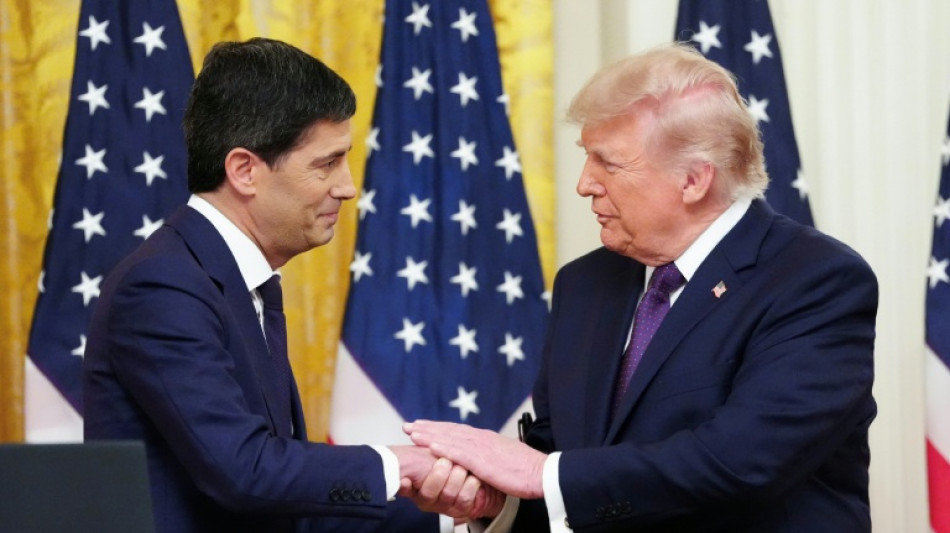
US Fed chair says will be 'reform-oriented' at glitzy White House swearing-in / Photo: © AFP

 London
 21 °C
21 °C
 Manchester
19 °C
Manchester
19 °C
 Glasgow
15 °C
Glasgow
15 °C
 Dublin
19 °C
Dublin
19 °C
 Belfast
16 °C
Belfast
16 °C
 Washington
 13 °C
13 °C
 Denver
14 °C
Denver
14 °C
 Atlanta
17 °C
Atlanta
17 °C
 Dallas
25 °C
Dallas
25 °C
 Houston Texas
27 °C
Houston Texas
27 °C
 New Orleans
25 °C
New Orleans
25 °C
 El Paso
 17 °C
17 °C
 Phoenix
 28 °C
28 °C
 Los Angeles
20 °C
San Diego
20 °C
San Francisco
Los Angeles
20 °C
San Diego
20 °C
San Francisco
 15 °C
Chicago
16 °C
Minneapolis
13 °C
Seattle
11 °C
Portland
9 °C
Salt Lake City
13 °C
Las Vegas
22 °C
Miami
15 °C
Chicago
16 °C
Minneapolis
13 °C
Seattle
11 °C
Portland
9 °C
Salt Lake City
13 °C
Las Vegas
22 °C
Miami
 26 °C
Jacksonville
22 °C
San Antonio
25 °C
Bermuda
26 °C
Nassau
14 °C
Iqaluit
5 °C
Yellowknife
26 °C
Jacksonville
22 °C
San Antonio
25 °C
Bermuda
26 °C
Nassau
14 °C
Iqaluit
5 °C
Yellowknife
 9 °C
Anchorage
9 °C
Anchorage
 2 °C
Fairbanks
-1 °C
Barrow
-2 °C
Calgary
7 °C
Edmonton
19 °C
Winnipeg
14 °C
Goose Bay
10 °C
Halifax
15 °C
Boston
13 °C
Ottawa
12 °C
Toronto
15 °C
Detroit
15 °C
Cleveland
13 °C
New York
13 °C
Baltimore
13 °C
Philadelphia
13 °C
Nuuk (Godthåb)
2 °C
Hong Kong
28 °C
Singapore
29 °C
Melbourne
27 °C
Canberra
13 °C
Adelaide
21 °C
Darwin
27 °C
Perth
16 °C
Fort Worth
26 °C
Honolulu
25 °C
Sydney
18 °C
Johannesburg
27 °C
Dubai
36 °C
Mumbai
30 °C
Zürich
21 °C
Tokyo
25 °C
Seoul
21 °C
Delhi
33 °C
Beijing
19 °C
Riyadh
41 °C
Prague
15 °C
Pennsylvania
11 °C
Valletta
27 °C
Manama
39 °C
Warsaw
14 °C
Stockholm
16 °C
2 °C
Fairbanks
-1 °C
Barrow
-2 °C
Calgary
7 °C
Edmonton
19 °C
Winnipeg
14 °C
Goose Bay
10 °C
Halifax
15 °C
Boston
13 °C
Ottawa
12 °C
Toronto
15 °C
Detroit
15 °C
Cleveland
13 °C
New York
13 °C
Baltimore
13 °C
Philadelphia
13 °C
Nuuk (Godthåb)
2 °C
Hong Kong
28 °C
Singapore
29 °C
Melbourne
27 °C
Canberra
13 °C
Adelaide
21 °C
Darwin
27 °C
Perth
16 °C
Fort Worth
26 °C
Honolulu
25 °C
Sydney
18 °C
Johannesburg
27 °C
Dubai
36 °C
Mumbai
30 °C
Zürich
21 °C
Tokyo
25 °C
Seoul
21 °C
Delhi
33 °C
Beijing
19 °C
Riyadh
41 °C
Prague
15 °C
Pennsylvania
11 °C
Valletta
27 °C
Manama
39 °C
Warsaw
14 °C
Stockholm
16 °C
New US Federal Reserve Chair Kevin Warsh vowed to be "reform-oriented" as he was sworn in at the White House on Friday, with President Donald Trump insisting the central bank chief would be "totally independent."
Trump has exerted unprecedented pressure on the central bank to reduce interest rates, attempting to fire a Fed governor and pursuing a criminal probe against Warsh's predecessor Jerome Powell.
"I will lead a reform-oriented Federal Reserve, learning from past successes and mistakes both, escaping static frameworks and models, and upholding clear standards of integrity and performance," Warsh said.
He called for central bankers to pursue their goals "with wisdom and clarity, independence and resolve," adding that "inflation can be lower, growth stronger, real take-home pay higher, and America can be more prosperous" if they did so.
Trump, who frequently criticized and insulted Powell, praised Warsh and said he wanted him to be fully independent, before urging the Fed chair to let the economy "boom."
"Kevin understands that when the economy is booming, that's a good thing. We want to stop inflation, but we don't want to stop greatness," Trump said.
Warsh has backed rate cuts in the past, even as the world's largest economy faces inflation at a three-year high.
It is unusual for the chief of the Fed -- an independent nonpartisan body that sets monetary policy according to a dual mandate on inflation and employment -- to be sworn in at the White House.
The last central bank chief to do so was Alan Greenspan in 1987, under President Ronald Reagan, who Warsh referenced in his speech as a role model.
At his Senate confirmation hearing, Warsh insisted that he would "absolutely not" be a puppet for Trump.
- Lavish ceremony -
Supreme Court Justices Clarence Thomas and Brett Kavanaugh were among those in attendance at the glitzy ceremony on Friday, with the former administering the oath of office to Warsh.
The court is due to rule on Trump's attempt to fire Fed Governor Lisa Cook.
A lengthy list of dignitaries in attendance included former vice president Dan Quayle, former Secretary of State Condoleezza Rice, alongside a slew of serving officials -- including the CIA director.
Trump and Warsh walked into the East Room together all smiles -- a stark contrast to the Republican's only televised meeting with Powell in his second term, where he berated the then Fed chair.
- Balancing mandates -
Warsh will take over a divided Fed facing high inflation -- fueled by the energy price surge that resulted from Trump's war on Iran -- and a labor market showing signs of weakness.
The US central bank has a dual mandate to keep inflation to its long-term target of two percent while also maintaining maximum employment.
US consumer inflation in April came in at 3.8 percent, a three-year high, with American households battered by years of above-expected price increases since the pandemic.
At a Fed meeting last month, a majority of policymakers indicated that rate hikes may be necessary if inflation remains above the Fed's long-term target.
Warsh has argued that productivity gains from artificial intelligence-led innovation will allow the US economy to grow rapidly without adding to inflation.
The US unemployment rate has remained relatively stable around 4.3 percent for the last year. But job growth -- often used as a proxy for economic activity -- has see-sawed between expansion and contraction from month to month.
That situation -- high inflation and inconsistent job growth -- has left the Fed in a potentially sticky situation of having to choose between its mandates.
"Kevin Warsh will not be able to deliver the rate cuts that the president wants," said David Wessel, senior fellow at the Brookings Institution.
"At some point, the president may grow impatient and will begin attacking Mr. Warsh as he did Jerome Powell."
Warsh takes over at "a time of disruption and rebalancing in the overall authority of the president," said Columbia Law professor Kathryn Judge, whose research focuses on central banking.
Potentially adding to Warsh's challenges will be the fact that Powell has chosen to remain on the board as a member -- an unusual but not unprecedented move for an outgoing chair.
Powell cited threats to the Fed's independence as the reason for his decision.
On Friday, White House economic advisor Kevin Hassett said he hoped Powell would soon "step aside" so Warsh could "have complete and easy control of the Fed."
F.Jankowski--GL