Pioneering US labor leader Dolores Huerta dies at 96 / Photo: © AFP

 London
 13 °C

 Manchester
 12 °C
 Glasgow
 9 °C
 Dublin
 13 °C
 Belfast
12 °C
 Washington
20 °C
 Denver
19 °C
 Atlanta
 23 °C
 Dallas
 27 °C
 Houston Texas
27 °C
 New Orleans
 25 °C
 El Paso
 24 °C
 Phoenix
27 °C
 Los Angeles
23 °C
San Diego
23 °C
San Francisco
18 °C
Chicago
24 °C
Minneapolis
20 °C
Seattle
11 °C
Portland
12 °C
Salt Lake City
15 °C
Las Vegas
24 °C
Miami
30 °C
Jacksonville
24 °C
San Antonio
28 °C
Bermuda
25 °C
Nassau
16 °C
Iqaluit
-12 °C
Yellowknife
-5 °C
Anchorage
-1 °C
Fairbanks
-6 °C
Barrow
-1 °C
Calgary
-1 °C
Edmonton
25 °C
Winnipeg
10 °C
Goose Bay
12 °C
Halifax
13 °C
Boston
12 °C
Ottawa
7 °C
Toronto
15 °C
Detroit
23 °C
Cleveland
23 °C
New York
17 °C
Baltimore
18 °C
Philadelphia
19 °C
Nuuk (Godthåb)
-3 °C
Hong Kong
26 °C
Singapore
26 °C
Melbourne
25 °C
Canberra
4 °C
Adelaide
11 °C
Darwin
27 °C
Perth
17 °C
Fort Worth
27 °C
Honolulu
 24 °C
Sydney
12 °C
Johannesburg
20 °C
Dubai
30 °C
Mumbai
30 °C
Zürich
10 °C
Tokyo
12 °C
Seoul
2 °C
Delhi
19 °C
Beijing
7 °C
Riyadh
29 °C
Prague
 9 °C
Pennsylvania
18 °C
Valletta
19 °C
Manama
31 °C
Warsaw
10 °C
Stockholm
8 °C
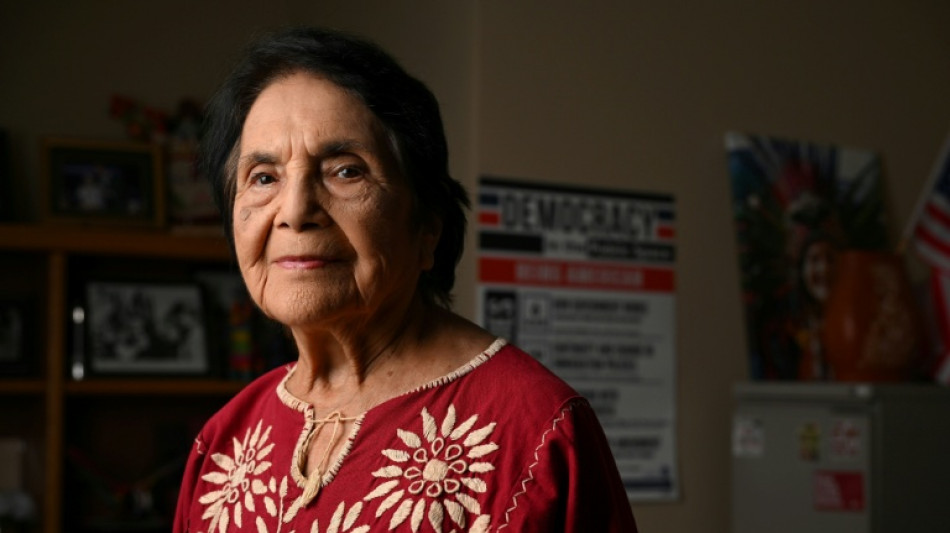
Dolores Huerta, the US labor leader and civil rights icon whose union work changed the lives of migrant workers, has died, her family said Wednesday. She was 96.
For nearly four decades Huerta was vice president of United Farm Workers, the union she founded with Cesar Chavez, organizing strikes and walkouts that won improvements in working conditions for the millions of men and women who labor in US fields.
"We are deeply saddened to announce that our beloved mother, Dolores Huerta, has passed away today at the age of 96," said a family statement.
"We know that many of you around the world share in our mourning, and we will be following up on plans to recognize and celebrate her incredible life and legacy."
Erik Olvera, a spokesman for her family, told AFP Wednesday that Huerta died of cancer in the morning surrounded by loved ones.
Born in New Mexico and raised in California, Huerta took the reins of the US farmworker movement in the 1960s with Chavez.
At the time, she was raising seven children -- she later had more -- while going through a divorce.
While Huerta was the organizing force behind the union, Chavez was its charismatic leader and the public face who became an icon to generations on the left, even after his death in 1993.
But that fame and the seemingly tight relationship between him and Huerta hid a dark secret that came to light this year, when Huerta said she was one of a number of women Chavez had raped.
In her case, the attacks resulted in two pregnancies.
"The first time... I didn't feel I could say no because he was someone that I admired, my boss and the leader of the movement I had already devoted years of my life to," she said in a statement to the New York Times, which broke the story.
"The second time I was forced, against my will, and in an environment where I felt trapped."
Huerta remained a galvanizing figure in left-wing politics well into her 90s, helping to organize a fightback among migrant laborers targeted by President Donald Trump's immigration swoops that saw farmworkers snatched from the fields by masked federal agents.
"People are reaching out because they want to do something," she told AFP during a July 2025 interview at the headquarters of her Dolores Huerta Foundation in Bakersfield, an agricultural nexus in California's Central Valley.
"We've got to be a lot more active, because what's happening right now is so huge. I liken it to what was happening in Germany before Hitler took power," she said.
- 'The best of us' -
Huerta rubbed shoulders with some of America's most influential people over decades in the public eye.
In 1968, she stood on a podium alongside Democratic presidential hopeful Robert F. Kennedy, brother of assassinated former president John F. Kennedy, just minutes before he was shot dead.
Barack Obama -- whose "Yes, we can" slogan he acknowledged he adopted from Dolores' "Si se puede" -- awarded her the presidential medal of freedom when he was in the White House.
News of Huerta's death prompted an outpouring of tributes from figures across the worlds of activism and politics, especially in her home state of California.
Governor Gavin Newsom ordered flags flown at half-staff in her honor, saying "Dolores represented the best of us" in her work that "changed the course of history against all odds."
Former president Bill Clinton praised her as a "dear friend" and "stalwart champion of working Americans."
"To see her in action was to witness a living legend who never stopped pushing for progress," Clinton said in a statement, "even as those efforts sometimes brought her grave consequences."
And California Representative Nancy Pelosi lauded Huerta's "courage and determination," saying the activist "inspired generations of Americans to believe in the power of collective action."
D.Kaminski--GL