Middle East war halts work at WHO's Dubai emergency hub / Photo: © AFP

 London
 11 °C
11 °C
 Manchester
 11 °C
11 °C
 Glasgow
9 °C
Glasgow
9 °C
 Dublin
17 °C
Dublin
17 °C
 Belfast
15 °C
Belfast
15 °C
 Washington
 20 °C
20 °C
 Denver
27 °C
Denver
27 °C
 Atlanta
24 °C
Atlanta
24 °C
 Dallas
 31 °C
31 °C
 Houston Texas
31 °C
Houston Texas
31 °C
 New Orleans
28 °C
New Orleans
28 °C
 El Paso
28 °C
El Paso
28 °C
 Phoenix
39 °C
Phoenix
39 °C
 Los Angeles
32 °C
San Diego
31 °C
San Francisco
Los Angeles
32 °C
San Diego
31 °C
San Francisco
 21 °C
Chicago
21 °C
Chicago
 19 °C
Minneapolis
17 °C
Seattle
21 °C
Portland
25 °C
Salt Lake City
28 °C
Las Vegas
37 °C
Miami
29 °C
Jacksonville
24 °C
San Antonio
32 °C
Bermuda
26 °C
Nassau
20 °C
Iqaluit
19 °C
Minneapolis
17 °C
Seattle
21 °C
Portland
25 °C
Salt Lake City
28 °C
Las Vegas
37 °C
Miami
29 °C
Jacksonville
24 °C
San Antonio
32 °C
Bermuda
26 °C
Nassau
20 °C
Iqaluit
 0 °C
Yellowknife
6 °C
Anchorage
0 °C
Yellowknife
6 °C
Anchorage
 8 °C
Fairbanks
2 °C
Barrow
-8 °C
Calgary
13 °C
Edmonton
23 °C
Winnipeg
15 °C
Goose Bay
12 °C
Halifax
14 °C
Boston
17 °C
Ottawa
13 °C
Toronto
15 °C
Detroit
18 °C
Cleveland
17 °C
New York
21 °C
Baltimore
21 °C
Philadelphia
19 °C
Nuuk (Godthåb)
2 °C
Hong Kong
8 °C
Fairbanks
2 °C
Barrow
-8 °C
Calgary
13 °C
Edmonton
23 °C
Winnipeg
15 °C
Goose Bay
12 °C
Halifax
14 °C
Boston
17 °C
Ottawa
13 °C
Toronto
15 °C
Detroit
18 °C
Cleveland
17 °C
New York
21 °C
Baltimore
21 °C
Philadelphia
19 °C
Nuuk (Godthåb)
2 °C
Hong Kong
 24 °C
Singapore
27 °C
Melbourne
25 °C
Canberra
14 °C
Adelaide
18 °C
Darwin
29 °C
Perth
16 °C
Fort Worth
31 °C
Honolulu
28 °C
Sydney
19 °C
Johannesburg
14 °C
Dubai
33 °C
Mumbai
30 °C
Zürich
10 °C
Tokyo
19 °C
Seoul
15 °C
Delhi
26 °C
Beijing
10 °C
Riyadh
30 °C
Prague
9 °C
Pennsylvania
17 °C
Valletta
25 °C
Manama
32 °C
Warsaw
14 °C
Stockholm
13 °C
24 °C
Singapore
27 °C
Melbourne
25 °C
Canberra
14 °C
Adelaide
18 °C
Darwin
29 °C
Perth
16 °C
Fort Worth
31 °C
Honolulu
28 °C
Sydney
19 °C
Johannesburg
14 °C
Dubai
33 °C
Mumbai
30 °C
Zürich
10 °C
Tokyo
19 °C
Seoul
15 °C
Delhi
26 °C
Beijing
10 °C
Riyadh
30 °C
Prague
9 °C
Pennsylvania
17 °C
Valletta
25 °C
Manama
32 °C
Warsaw
14 °C
Stockholm
13 °C
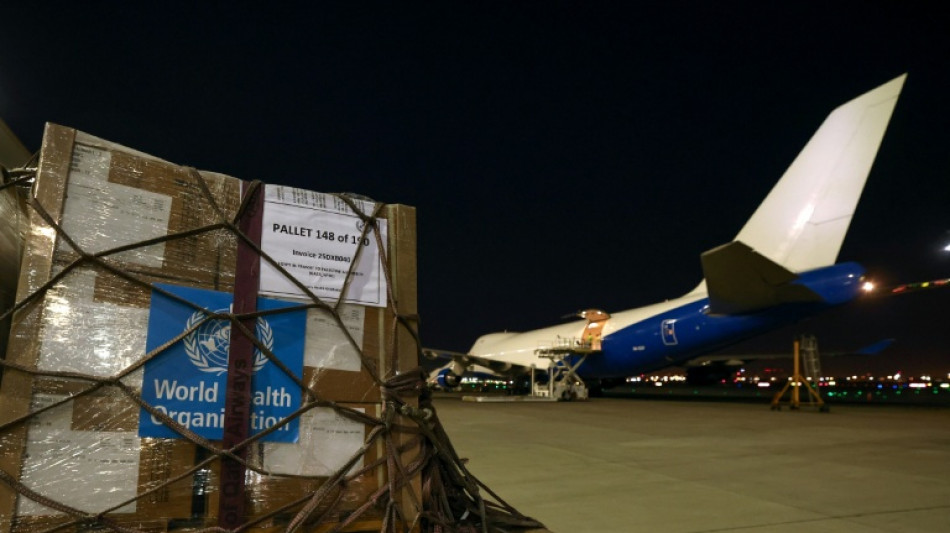
The Middle East war has forced the World Health Organization to suspend operations at its global emergency logistics hub in Dubai, the UN agency's chief said Thursday.
Tedros Adhanom Ghebreyesus warned that the impact of the conflict, sparked by the US-Israeli attacks on Iran on Saturday, "goes beyond the immediately affected countries".
"Operations at WHO's logistics hub for global health emergencies in Dubai are currently on hold due to insecurity," he told a press conference.
Last year, the Dubai logistics hub processed more than 500 emergency orders for 75 countries around the world, Hanan Balkhy, the WHO's Eastern Mediterranean regional director, told reporters.
"Humanitarian health supply chains are now being jeopardised," she warned.
Balkhy explained that "the hub's operations are temporarily on hold due to insecurity, airspace closures and restrictions affecting access to the Strait of Hormuz".
The disruption, she said, was "preventing access to $18 million in humanitarian health supplies while another $8 million in shipments cannot reach the hub".
It was affecting more than 50 emergency supply requests from 25 countries, as well as some $6 million in medicines destined for the war-torn Gaza Strip.
- 'Extremely important lifeline' -
On top of that, $1.6 million in polio laboratory supplies were being held up, which could have dire impacts for Afghanistan and Pakistan, where the disease is endemic, she cautioned.
Balkhy said the WHO was discussing and coordinating with authorities in the United Arab Emirates on how to continue using the hub.
It was also in discussions with other countries and humanitarian partners on using other hubs in Nairobi, Dakar and Brindisi to establish other routes.
If the conflict draws out, Balkhy acknowledged there could be a need to discuss "all types of potential road routes or ground routes, potentially through the Kingdom of Saudi Arabia", but said the WHO hoped it would not need to do so.
"The Dubai hub is an extremely important lifeline for the humanitarian response," she said.
- 'Nuclear risks' -
As for the direct impact of war, Balkhy said the UN health agency was coordinating the health response across 16 affected countries, and was supporting health ministries and partners "to sustain essential services".
The WHO was also "strengthening disease surveillance and preparing for potential mass casualties and displacement", she said.
Iran meanwhile had not made any "formal request for any specific supplies" from WHO, "as their system is withholding and withstanding the current situation", Balkhy said.
But she said the WHO was "scaling readiness for chemical, biological, radiological and nuclear risks".
Tedros also pointed to the threats to nuclear facilities posed by the conflict.
"Any compromise to nuclear safety could have serious public health consequences," he warned.
The WHO also sounded the alarm over the more than a dozen attacks on healthcare registered by Thursday in the not even one-week-old conflict.
The organisation said it had so far verified 13 attacks on healthcare in Iran, killing four people and injuring 25, while an attack in Lebanon killed three paramedics and injured six others.
"Under international humanitarian law, health care must be protected and not attacked," Tedros said.
O.Kubiak--GL