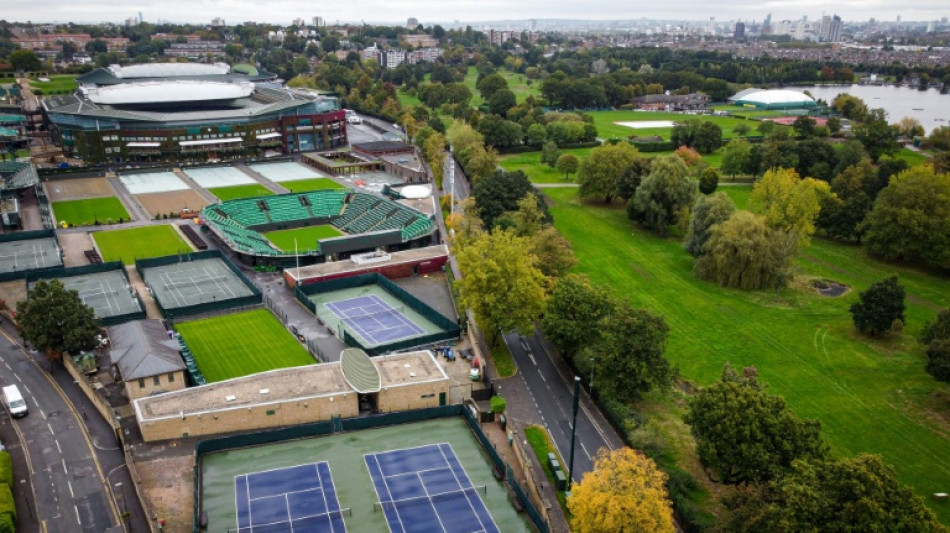
Court battle plays out over Wimbledon tennis expansion plan / Photo: © AFP

 London
 19 °C
19 °C

 Manchester
16 °C
Manchester
16 °C
 Glasgow
 18 °C
18 °C
 Dublin
 12 °C
12 °C
 Belfast
12 °C
Belfast
12 °C
 Washington
22 °C
Washington
22 °C
 Denver
 17 °C
17 °C
 Atlanta
 22 °C
22 °C
 Dallas
 27 °C
27 °C
 Houston Texas
25 °C
Houston Texas
25 °C
 New Orleans
24 °C
New Orleans
24 °C
 El Paso
20 °C
El Paso
20 °C
 Phoenix
27 °C
Phoenix
27 °C
 Los Angeles
18 °C
San Diego
20 °C
San Francisco
15 °C
Chicago
19 °C
Minneapolis
16 °C
Seattle
13 °C
Portland
13 °C
Salt Lake City
19 °C
Las Vegas
26 °C
Miami
26 °C
Jacksonville
24 °C
San Antonio
25 °C
Bermuda
Los Angeles
18 °C
San Diego
20 °C
San Francisco
15 °C
Chicago
19 °C
Minneapolis
16 °C
Seattle
13 °C
Portland
13 °C
Salt Lake City
19 °C
Las Vegas
26 °C
Miami
26 °C
Jacksonville
24 °C
San Antonio
25 °C
Bermuda
 27 °C
Nassau
23 °C
Iqaluit
2 °C
Yellowknife
7 °C
Anchorage
27 °C
Nassau
23 °C
Iqaluit
2 °C
Yellowknife
7 °C
Anchorage
 10 °C
Fairbanks
5 °C
Barrow
-1 °C
Calgary
8 °C
Edmonton
21 °C
Winnipeg
8 °C
Goose Bay
14 °C
Halifax
18 °C
Boston
19 °C
Ottawa
13 °C
Toronto
14 °C
Detroit
15 °C
Cleveland
20 °C
New York
10 °C
Fairbanks
5 °C
Barrow
-1 °C
Calgary
8 °C
Edmonton
21 °C
Winnipeg
8 °C
Goose Bay
14 °C
Halifax
18 °C
Boston
19 °C
Ottawa
13 °C
Toronto
14 °C
Detroit
15 °C
Cleveland
20 °C
New York
 24 °C
Baltimore
23 °C
Philadelphia
22 °C
Nuuk (Godthåb)
3 °C
Hong Kong
27 °C
Singapore
31 °C
Melbourne
26 °C
Canberra
11 °C
Adelaide
15 °C
Darwin
27 °C
Perth
16 °C
Fort Worth
25 °C
Honolulu
26 °C
Sydney
15 °C
Johannesburg
18 °C
Dubai
39 °C
Mumbai
28 °C
Zürich
20 °C
Tokyo
23 °C
Seoul
25 °C
Delhi
34 °C
Beijing
24 °C
Riyadh
43 °C
Prague
22 °C
Pennsylvania
22 °C
Valletta
27 °C
Manama
38 °C
Warsaw
21 °C
Stockholm
17 °C
24 °C
Baltimore
23 °C
Philadelphia
22 °C
Nuuk (Godthåb)
3 °C
Hong Kong
27 °C
Singapore
31 °C
Melbourne
26 °C
Canberra
11 °C
Adelaide
15 °C
Darwin
27 °C
Perth
16 °C
Fort Worth
25 °C
Honolulu
26 °C
Sydney
15 °C
Johannesburg
18 °C
Dubai
39 °C
Mumbai
28 °C
Zürich
20 °C
Tokyo
23 °C
Seoul
25 °C
Delhi
34 °C
Beijing
24 °C
Riyadh
43 °C
Prague
22 °C
Pennsylvania
22 °C
Valletta
27 °C
Manama
38 °C
Warsaw
21 °C
Stockholm
17 °C
A clash over the future of the Wimbledon tennis championships is being played out away from the manicured southwest London courts set to welcome the world's best players next week.
On one side sits the All England Lawn Tennis Club (AELTC), organisers of the only grass-court Grand Slam, which wants to triple the size of its historic grounds.
Its opponent: local residents, who argue the plans threaten the leafy suburban area's natural environment.
The tussle -- currently working its way through England's courts -- has been ongoing for five years.
The AELTC is trying to expand its storied site, where it has held a tournament since 1877, to hold qualifying rounds there.
The qualifiers, which concluded for this year's championships on Thursday, are currently held several kilometres (miles) away at a leased courts complex in Roehampton.
"We need a permanent home for our qualifying," AELTC chair Deborah Jevans told a recent press conference.
"It's important because if you look at Roland Garros, if you look at the US Open, you look at the Australian (Open), all of them have their qualifying on-site. We're the only one that doesn't."
She added: "We want it to be close to the main site, like the others, and we're unable to do so until we go through these legal challenges."
- 'David against Goliath' -
Wimbledon Park, a green space and lake created in the 18th century and sitting opposite the tournament site, is central to the battle.
Previously home to Wimbledon Park Golf Club, the AELTC wants to build 38 new tennis courts and an 8,000-seat stadium there.
It comes as the Grand Slams -- also held in Melbourne, Paris and New York -- try to innovate to boost ticket sales for their qualifying weeks.
The US Open last year controversially launched a new stand-alone mixed doubles competition held before its Grand Slam tournament and tailored to feature more singles stars.
Meanwhile Australia in 2025 staged its inaugural "One Point Slam" -- sudden-death contests consisting of just one point which pit professionals alongside amateurs and celebrity wildcards.
But Wimbledon's bid to use the park on its doorstep as a launchpad for its own modernisation has met fierce resistance from local residents.
They have formed the "Save Wimbledon Park" (SWP) group -- which currently boasts 25 members -- to fight the proposals.
"The campaign started five years ago, when they launched the plans," retired lawyer Christopher Coombe, who has lived nearby for 34 years and is a regular spectator at the tennis tournament, told AFP. "We've got in their way."
Fellow retiree and SWP member Jonathan Morrish, a Wimbledon resident for 45 years, added: "We often use the analogy David against Goliath".
"They are destroying one of their unique selling points: the beauty of their location," he said.
"Imagine a stadium the size of the Royal Albert Hall dominating here," Morrish added, referring to the grand 5,272-seat concert hall to the north in Kensington, as he gestured towards the threatened park.
He compares Wimbledon to "a nice village". "It's just madness wanting to build on green areas."
- 'Benefits' -
The quarrel mirrors the recent expansion of Roland Garros, the clay courts that have hosted the French Open for more than a century.
The French Tennis Federation, which organises that annual showpiece, battled in the courts for five years to build the 5,000-seat Simonne-Mathieu stadium and several other additions.
Concerns about that project centred on the impact on 19th century greenhouses in the adjacent Auteuil gardens home to rare flora and fauna.
The federation eventually prevailed in 2017 and opened the new arena in 2019, increasing the size of its southwest Paris site by 50 percent.
In London, the SWP campaigners argued the development should not proceed because a statutory trust exists under 19th century legislation requiring the land only be used for "public walks" or as "pleasure grounds".
Lawyers for the club countered that it was never subject to a trust and, if it was, it did not survive the club's purchase of the freehold in 1993.
In March, the High Court ruled in favour of the AELTC, though SWP has said it would ask the Court of Appeal to review the decision.
Meanwhile, the group has also challenged the planning permission granted in 2024 by the Greater London Authority.
The High Court also dismissed that claim, but the Court of Appeal is scheduled to hear that case in October.
Jevans has insisted the project will bring "benefits", including a new 27-acre park -- which adds 50 percent more public space -- a lake boardwalk, children's playgrounds and new multi-sport facility.
But she conceded that "depending on appeals and results, it could be a number of years before we're able to move there".
M.Kowalski--GL