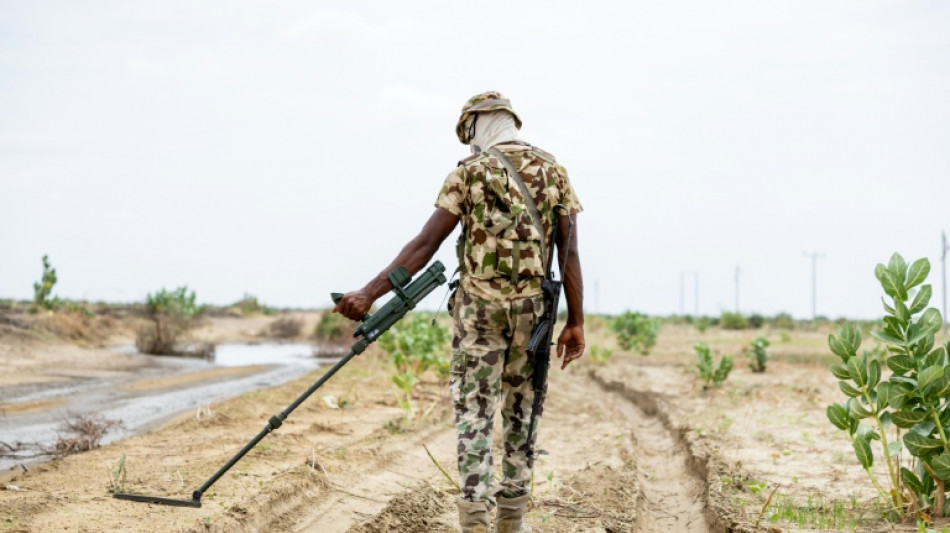
Jihadist insurgency hampers Nigeria cholera outbreak response / Photo: © AFP

 London
 20 °C
20 °C

 Manchester
 15 °C
15 °C
 Glasgow
 18 °C
18 °C
 Dublin
17 °C
Dublin
17 °C
 Belfast
16 °C
Belfast
16 °C
 Washington
 25 °C
25 °C
 Denver
19 °C
Denver
19 °C
 Atlanta
26 °C
Atlanta
26 °C
 Dallas
 31 °C
31 °C
 Houston Texas
31 °C
Houston Texas
31 °C
 New Orleans
30 °C
New Orleans
30 °C
 El Paso
22 °C
El Paso
22 °C
 Phoenix
31 °C
Phoenix
31 °C
 Los Angeles
21 °C
San Diego
21 °C
San Francisco
15 °C
Chicago
22 °C
Minneapolis
18 °C
Seattle
12 °C
Portland
13 °C
Salt Lake City
21 °C
Las Vegas
28 °C
Miami
31 °C
Jacksonville
29 °C
San Antonio
29 °C
Bermuda
29 °C
Nassau
21 °C
Iqaluit
5 °C
Yellowknife
4 °C
Anchorage
Los Angeles
21 °C
San Diego
21 °C
San Francisco
15 °C
Chicago
22 °C
Minneapolis
18 °C
Seattle
12 °C
Portland
13 °C
Salt Lake City
21 °C
Las Vegas
28 °C
Miami
31 °C
Jacksonville
29 °C
San Antonio
29 °C
Bermuda
29 °C
Nassau
21 °C
Iqaluit
5 °C
Yellowknife
4 °C
Anchorage
 11 °C
Fairbanks
11 °C
Fairbanks
 8 °C
Barrow
-1 °C
Calgary
6 °C
Edmonton
30 °C
Winnipeg
10 °C
Goose Bay
21 °C
Halifax
21 °C
Boston
22 °C
Ottawa
22 °C
Toronto
24 °C
Detroit
20 °C
Cleveland
26 °C
New York
22 °C
Baltimore
25 °C
Philadelphia
23 °C
Nuuk (Godthåb)
5 °C
Hong Kong
8 °C
Barrow
-1 °C
Calgary
6 °C
Edmonton
30 °C
Winnipeg
10 °C
Goose Bay
21 °C
Halifax
21 °C
Boston
22 °C
Ottawa
22 °C
Toronto
24 °C
Detroit
20 °C
Cleveland
26 °C
New York
22 °C
Baltimore
25 °C
Philadelphia
23 °C
Nuuk (Godthåb)
5 °C
Hong Kong
 28 °C
Singapore
29 °C
Melbourne
27 °C
Canberra
3 °C
Adelaide
10 °C
Darwin
27 °C
Perth
20 °C
Fort Worth
31 °C
Honolulu
25 °C
Sydney
28 °C
Singapore
29 °C
Melbourne
27 °C
Canberra
3 °C
Adelaide
10 °C
Darwin
27 °C
Perth
20 °C
Fort Worth
31 °C
Honolulu
25 °C
Sydney
 12 °C
Johannesburg
25 °C
Dubai
35 °C
Mumbai
29 °C
Zürich
16 °C
Tokyo
20 °C
Seoul
17 °C
Delhi
31 °C
Beijing
20 °C
Riyadh
38 °C
Prague
23 °C
Pennsylvania
23 °C
Valletta
28 °C
Manama
37 °C
Warsaw
23 °C
Stockholm
17 °C
12 °C
Johannesburg
25 °C
Dubai
35 °C
Mumbai
29 °C
Zürich
16 °C
Tokyo
20 °C
Seoul
17 °C
Delhi
31 °C
Beijing
20 °C
Riyadh
38 °C
Prague
23 °C
Pennsylvania
23 °C
Valletta
28 °C
Manama
37 °C
Warsaw
23 °C
Stockholm
17 °C
A cholera outbreak in jihadist-hit northeast Nigeria has killed dozens as insecurity and a lack of health infrastructure hampers the response, medical sources and local residents told AFP Friday.
Communities in the Lake Chad region, where Islamic State West Africa Province (ISWAP) controls swathes of the countryside, have been hit by a wave of cases that residents said was spiralling out of control.
The outbreak, which started mid-June, comes after more than 70 died from an earlier surge of the waterborne illness in and around state capital Maiduguri.
Now, a rural outbreak has spiked over the past two weeks in communities on the shores of Lake Chad, including in Doro, Bunduram, Baga, Kross Kauwa, as well as the garrison town of Monguno, residents said.
"We receive on the average 50 patients daily, 40 percent of whom die," said a medical source at a clinic in Monguno, a city whose military base makes it a hub for medical, government and NGO operations.
"The mortality was between two and five daily, but in the past two weeks the situation has worsened with the influx of patients from remote farming communities," said the source, who asked not to be identified for personal safety.
Cholera is spread by bacteria-tainted water and food, and can cause dehydration and diarrhoea.
Modern sewage treatment has all but eliminated the disease in much of the world.
But war, conflict and poverty -- all familiar in Borno state, the epicentre of a long-running insurgency -- are major risk factors for an outbreak.
Due to the distance they travel and lack of first aid services along the way, patients from remote areas often reach Monguno in dire straits, the source said.
The exact toll is unclear.
A spokesman for the Borno state governor did not immediately respond to a request for comment.
- Jihadists also battling outbreak -
The disease appears to have been spread in part by farmers who had moved deep into the bush to cultivate land under jihadist control, anti-jihadist militia member Labo Sani told AFP.
ISWAP and rival Boko Haram militants have imposed levies on farmers for permission to cultivate their fields. Those who default or refuse are shot.
In recent weeks, some farmers from Gwoza, near the border with Cameroon, where Boko Haram is active, moved to farm areas in Kukawa and Monguno districts, which are under ISWAP control, said Sallau Arzika, a fisherman from Baga.
"The majority of the cholera victims are farmers from Gwoza who work deep inside the bush where the outbreak is most severe," Sani said.
The outbreak prompted the establishment of two isolation centres in Doro and Bunduram, where patients are treated by a few local medical personnel with "grossly inadequate" medical supplies, Sani added.
The mortality rate is worsened by a nighttime curfew in place to prevent jihadist attacks -- but which also forces people to wait until daybreak to get medical care, he said.
The jihadists themselves are also affected by the cholera outbreak, said Ibrahim Liman, another anti-jihadist militia member.
ISWAP commanders have been discussing how to tackle it, he told AFP, citing intelligence gathered on the group -- though "it is difficult to assess how bad the terrorists have been hit".
- Shifting front lines -
Between May and June, 14 districts in Borno state, including in the state capital Maiduguri, recorded a "suspected cholera" outbreak that infected around 8,000 people and killed 74, according to Doctors Without Borders.
That wave was brought under control, a United Nations source told AFP.
But now that the disease has reached Baga, fighting it could be difficult because of insecurity in the area.
Baga suffered a serious cholera outbreak eight years ago which was quickly brought under control.
"In 2018 it was very bad in Baga. Because it was relatively safe, we responded. Now it is not safe," the source said.
T.Ostrowski--GL