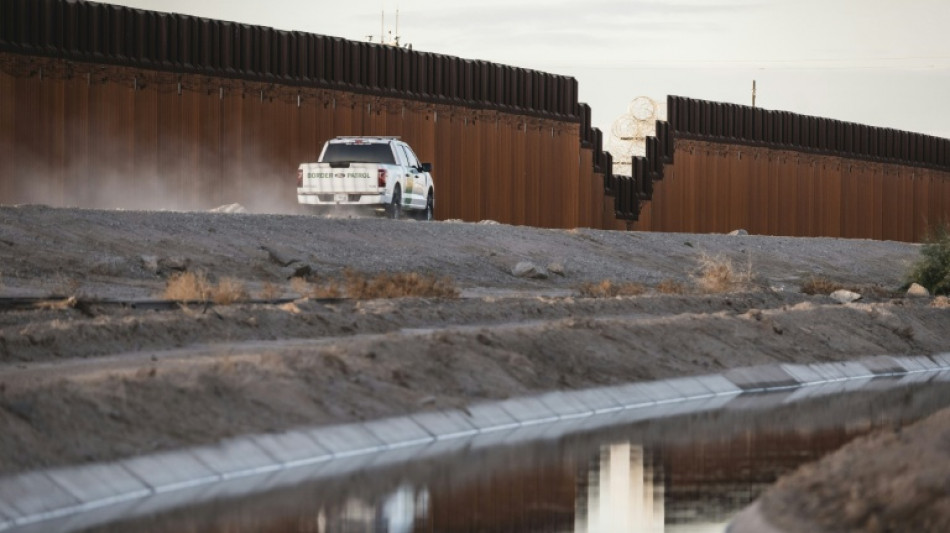
Trump's border: quiet, but few people are happy / Photo: © AFP

 London
 12 °C

 Manchester
 9 °C
 Glasgow
10 °C
 Dublin
11 °C
 Belfast
10 °C
 Washington
 14 °C
 Denver
13 °C
 Atlanta
18 °C
 Dallas
24 °C
 Houston Texas
23 °C
 New Orleans
20 °C
 El Paso
 23 °C
 Phoenix
26 °C
 Los Angeles
20 °C
San Diego
20 °C
San Francisco
16 °C
Chicago
21 °C
Minneapolis
16 °C
Seattle
10 °C
Portland
 10 °C
Salt Lake City
11 °C
Las Vegas
23 °C
Miami
26 °C
Jacksonville
22 °C
San Antonio
25 °C
Bermuda
23 °C
Nassau
13 °C
Iqaluit
-15 °C
Yellowknife
-8 °C
Anchorage
 1 °C
Fairbanks
 -2 °C
Barrow
 0 °C
Calgary
-3 °C
Edmonton
17 °C
Winnipeg
5 °C
Goose Bay
6 °C
Halifax
6 °C
Boston
8 °C
Ottawa
4 °C
Toronto
9 °C
Detroit
15 °C
Cleveland
15 °C
New York
14 °C
Baltimore
13 °C
Philadelphia
14 °C
Nuuk (Godthåb)
-4 °C
Hong Kong
27 °C
Singapore
 28 °C
Melbourne
25 °C
Canberra
20 °C
Adelaide
21 °C
Darwin
32 °C
Perth
24 °C
Fort Worth
24 °C
Honolulu
26 °C
Sydney
21 °C
Johannesburg
16 °C
Dubai
28 °C
Mumbai
28 °C
Zürich
7 °C
Tokyo
14 °C
Seoul
8 °C
Delhi
20 °C
Beijing
11 °C
Riyadh
26 °C
Prague
9 °C
Pennsylvania
11 °C
Valletta
18 °C
Manama
30 °C
Warsaw
8 °C
Stockholm
4 °C
Between the hundreds of migrants arriving every day to seek asylum, chases of those fleeing, and the encounters with drug traffickers, Jason Mercado was overwhelmed during his time working for the US Border Patrol under Joe Biden.
"It's peaceful now," the retired agent says as he stands in front of the enormous wall that separates the United States from Mexico, near the town of San Luis, Arizona.
On the eve of the midterm elections, this arid region in the Southwest serves as proof that Donald Trump kept his central campaign promise: to restore order at the border.
In the sector around San Luis, the Border Patrol now apprehends fewer than 10 people per day -- a sharp decline from the up to 2,000 per day under the last administration.
This drop, which began during the final months of the Biden presidency, accelerated under the Republican billionaire's aggressive anti-immigration offensive.
Now filing an asylum claim at the border has become extremely difficult; migrants apprehended near the wall are almost never released while awaiting a hearing; and high-profile, forceful operations targeting undocumented immigrants across the United States have served as a deterrent.
Mercado's former colleagues tell him that during their patrols, things are "very quiet."
"One or two of them said the word 'boring,'" says the 56-year-old, a Republican voter, with a smile.
- Relief -
In the small town of San Luis, the sense of relief is palpable, even among Democrats, who sometimes struggled with the scope of the humanitarian crisis.
Churches and community organizations provided food and shelter for thousands of people in transit, while the hospital in Yuma, the county seat, was completely overwhelmed, and the federal government still owes it millions.
"Our tax dollars were going toward all of that," says Georgina Escamilla, speaking in Spanish in her Mexican restaurant.
"They were giving money to people coming from other countries, while those who live here receive no help," adds the 63-year-old, who leans to the left politically.
Yet, the return of calm masks a new sense of unease among the residents of this agricultural region -- one of the country’s primary producers of lettuce and other vegetables.
"With Trump, we've shot ourselves in the foot," complains Ricardo Vasquez.
The 58-year-old farmworker is frustrated that he now has to pay more than 20 percent more for diesel, a cost he attributes to the conflict in Iran initiated by the president.
"The country wasn't doing so badly before he arrived, and now, with fuel prices, it feels like we're being slapped in the face, because everything is going up," he grumbles.
In his fields of lettuce and broccoli, Mike Pasquinelli no longer has to worry about the destruction caused by migrants fleeing the police -- incidents that previously wiped out portions of his harvest.
However, the surge in the cost of diesel and fertilizers, driven by the conflict in the Middle East, is eating into his bottom line.
- 'Uncertainty' -
"We're probably gonna have about a 20 percent reduction in profits... compared to last year," sighs the farmer, who serves as president of the Yuma Fresh Vegetables Association.
He has also had to contend with a drop in orders, stemming from tensions linked to the trade war with Canada, a major destination for his vegetable exports.
"There's been a lot of uncertainty on the foreign market, especially with the tariffs and retaliation between countries," he says.
"Most of the market has stabilized, but we've had some ups and downs."
This instability has also taken a toll on the logistics sector, another key employer in the region.
In his refrigerated warehouses, located right up against the border wall -- in an area through which dozens of trucks pass -- Mario Jauregui is fed up with "always playing the guessing game."
Tariffs, which have been repeatedly imposed and then lifted, have cut the volume of fruit his clients ship between Mexico and the United States by a fifth.
His industry is also facing setbacks because the Trump administration has stopped issuing commercial vehicle permits to certain foreign drivers.
"It's become so uncertain... nowadays that when we wake up the first thing that we do is look at the news," the conservative business owner grumbles.
"I don't think that that's a way to manage a country."
At 66, he has always voted Republican.
But with the November 3 election approaching, he finds himself hoping that Trump's Republican Party loses its congressional majority.
"I would much rather have a Democratic Congress and a Republican president," he says with a sigh. "We need to learn our lesson."
Z.Tomaszewski--GL