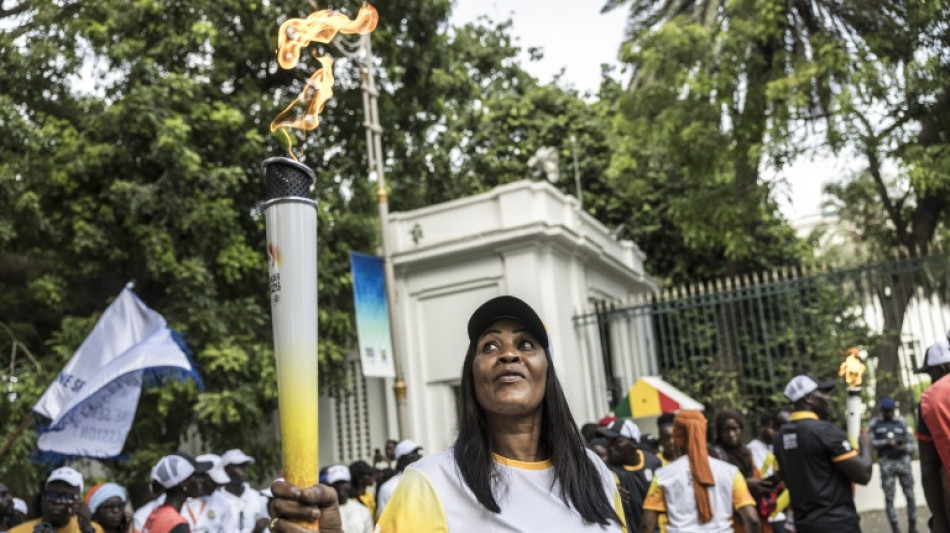
Sports chiefs face losing battle to keep sport separate from politics / Photo: © AFP/File

 London
 10 °C

 Manchester
 10 °C
 Glasgow
9 °C
 Dublin
 13 °C
 Belfast
 13 °C
 Washington
 16 °C
 Denver
13 °C
 Atlanta
17 °C
 Dallas
21 °C
 Houston Texas
23 °C
 New Orleans
21 °C
 El Paso
16 °C
 Phoenix
25 °C
 Los Angeles
20 °C
San Diego
20 °C
San Francisco
17 °C
Chicago
16 °C
Minneapolis
9 °C
Seattle
 9 °C
Portland
10 °C
Salt Lake City
12 °C
Las Vegas
23 °C
Miami
27 °C
Jacksonville
22 °C
San Antonio
21 °C
Bermuda
 22 °C
Nassau
15 °C
Iqaluit
 -11 °C
Yellowknife
-1 °C
Anchorage
 3 °C
Fairbanks
2 °C
Barrow
0 °C
Calgary
-3 °C
Edmonton
15 °C
Winnipeg
3 °C
Goose Bay
14 °C
Halifax
13 °C
Boston
15 °C
Ottawa
16 °C
Toronto
16 °C
Detroit
17 °C
Cleveland
19 °C
New York
16 °C
Baltimore
15 °C
Philadelphia
15 °C
Nuuk (Godthåb)
0 °C
Hong Kong
 28 °C
Singapore
29 °C
Melbourne
26 °C
Canberra
22 °C
Adelaide
28 °C
Darwin
31 °C
Perth
20 °C
Fort Worth
19 °C
Honolulu
26 °C
Sydney
24 °C
Johannesburg
14 °C
Dubai
29 °C
Mumbai
28 °C
Zürich
6 °C
Tokyo
15 °C
Seoul
14 °C
Delhi
19 °C
Beijing
13 °C
Riyadh
24 °C
Prague
4 °C
Pennsylvania
13 °C
Valletta
18 °C
Manama
28 °C
Warsaw
5 °C
Stockholm
7 °C
IOC president Kirsty Coventry's desire is that "politics does not take over on the field of play", but Ukraine and former executives from her organisation have told AFP that politics and sport remain inseparable.
Coventry's view will be sorely tested when Ukrainian and Russian athletes -- the nations embroiled in a war sparked by Russian President Vladimir Putin launching an invasion of Ukraine in 2022 -- compete side-by-side in the Youth Olympics which start in the Senegalese capital Dakar on Saturday.
The 13 Russian athletes will be able to parade with their national flag and hear their national anthem at an Olympic event for the first time since the 2020 Winter Youth Games in Lausanne.
The restoration of such symbols fits with the approach that Coventry indicated she would follow when she spoke at the EU Sporting Forum in Cyprus earlier this year.
"Athletes can only inspire us if they are able to compete," the Zimbabwean two-time Olympic swimming gold medallist said.
"They can only do so if we keep sport strictly neutral ground, if politics does not take over on the field of play," she added.
Ukraine Sports Minister Matviy Bidnyi dismisses that view.
"Any conversation about returning Russian athletes to the international arena can only happen after the war ends, a just peace is established, every single abducted Ukrainian child is returned home, and international law is fully restored," he told AFP.
"Until that moment, isolation is not political -- it is a matter of basic human decency."
Former International Olympic Committee marketing executive Terrence Burns told AFP that globally speaking, "sport has never been separate from politics".
"When I hear anyone use that phrase it sounds naive at best and cynical at worst," he said.
"The real principle is neutrality. The Olympic movement only works if it stays independent of governments."
Ukraine has not employed the political weapon of boycotting sporting events Russia have competed in, a strategy that was once fashionable -- three successive Summer Olympics from 1976 to 1984 were affected. In the latter two cases, the IOC was more impacted than their intended targets.
"The boycott agenda of the eighties very nearly destroyed the Olympic movement," Michael Payne, a former IOC marketing chief, told AFP.
"Eventually the politicians began to understand that maybe it was a good idea for the world to come together through sport."
Burns and Payne concede that the African boycott of the 1976 Montreal Games was effective because it highlighted a multilateral campaign to isolate apartheid South Africa from world sport.
"The lesson is that a boycott works when it is sustained, collective and aimed squarely at the wrongdoer," Burns said.
- 'Terrifying signal' -
Payne says sport is again open to political interference.
"Over the last decade, politicians have again turned to using sport as a tool to sanction, declaring who can and who cannot participate," he said.
"I have argued in my book 'Fast Tracks and Dark Deals', that the biggest single threat facing the future of sport is the growing political weaponisation of sport."
Politics and sport have occasionally combined to offer hope.
Both involved North and South Korea, technically still at war, but who paraded together at the 2000 Sydney Games and fielded a joint ice hockey team at the 2018 Winter Games in Pyeongchang.
Though hopes of a lasting improvement in relations failed to materialise, Burns believes it was an example of how sport can offer a tantalising glimpse of what could be possible.
"Sport opens doors but it can't make anyone walk through them," said Burns.
"Still, I think an open door is worth a great deal when every other one is shut."
While Coventry has pursued a line of neutrality, FIFA president Gianni Infantino has been accused by his critics of crossing the line in his close friendship with US President Donald Trump.
Awarding him the FIFA Peace Prize was widely ridiculed.
"It was a fake award, with no public criteria, jury or process," said Burns.
"I think that changed the perception of FIFA from working with a political leader to endorsing one. That's not neutrality."
Infantino has also opened the gates to Russia, who are competing at the Under-15 football World Cup this month, and has said the ban on the country has not "achieved anything, it has just created more frustration and hatred".
Bidnyi told AFP he "totally rejects this logic".
"Removing these bans would send a terrifying signal to any future aggressor: that you can invade a neighbour, commit atrocities, and still be welcomed at global tournaments as if nothing happened."
A.Walczak--GL